

The Burnout Solution: Professional Endurance And Emotional Intelligence

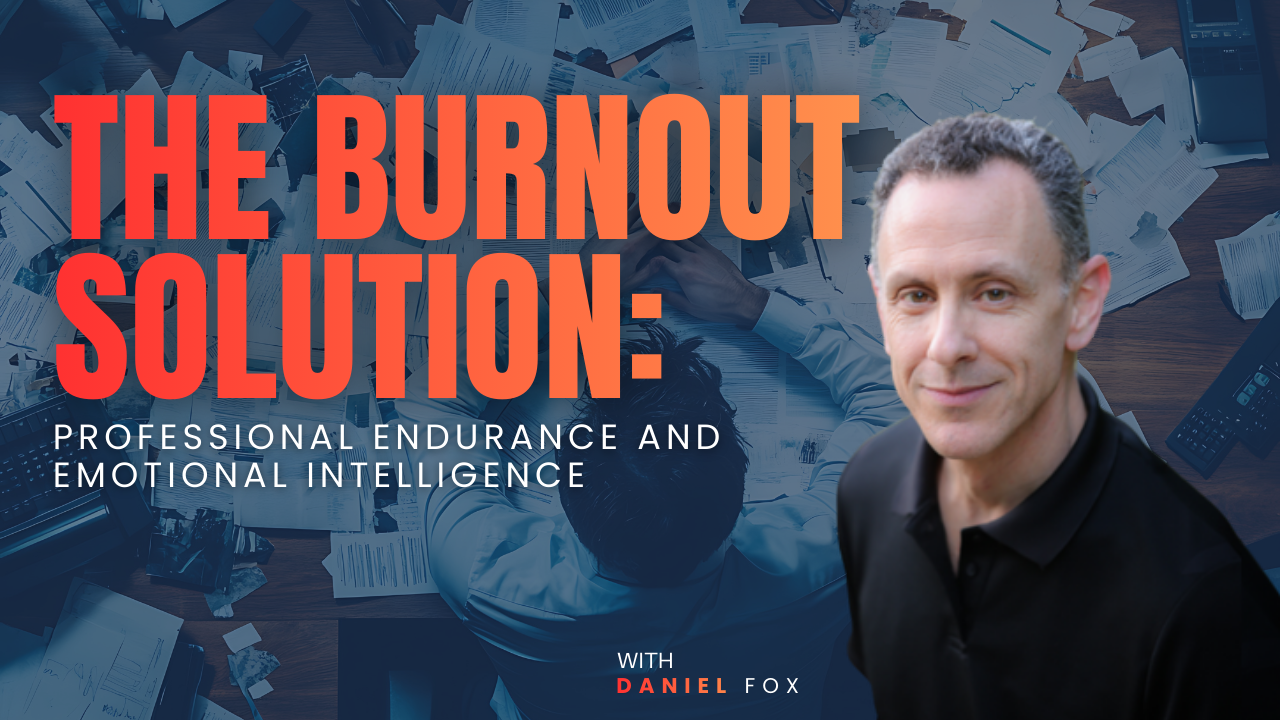
Daniel Fox starts with a warning about how people use training like this. Given a room full of options, most of us reach for the approach we already use, which is understandable and also the problem, because if you are burnt out then the approach you already use is the one that has not worked. He asks you to pick something you would not normally try and to give it long enough to mean anything, which he puts at considerably longer than most people manage.
He is a clinical psychologist in Texas who spent years working inside a federal prison system, and he is unsparing about organisational life: policies written by people who have not done the work in fifteen years, inconsistency between what is rewarded and what is said to matter, and the slow erosion that comes from both. A good deal of burnout, on his account, is not about the clients at all.
Four hours. He covers where burnout sits on a path rather than as a state you are either in or not, so you can locate yourself on it before it becomes urgent. Then the body: what prolonged stress does physically and neurologically, which is the part clinicians find hardest to apply to themselves. Then the emotional intelligence material that gives the course its second half, worked through as a set of capacities you can name and assess rather than a quality you have. Self-awareness, self-regulation, motivation, empathy and social competence, each broken into components, with the point being to identify which ones have degraded. He also spends time on professional alliances and on what negativity in the people around you does over a long period, including how to let some of that resolve itself.
You’ll walk away with
- A way of locating yourself on the path toward burnout, before it reaches the point of forcing a decision
- Why the techniques you naturally reach for are the ones least likely to help you now
- What prolonged stress does to the body and brain, applied to you rather than to a client
- The organisational conditions that produce burnout, separate from the clinical work itself
- Emotional intelligence broken into named capacities you can assess rather than a quality you either have or do not
- Self-awareness and self-regulation as specific skills, with what degradation in each looks like
- Empathy, influence and social competence at work, including reading the emotional currents in a team
- Building professional alliances that buffer stress rather than adding to it
- What sustained negativity in the people around you does over time, and what to do about it
- Re-engaging with clients and with the work, rather than only reducing the load
- Self-care techniques, and a realistic view of how long to give any of them before judging
Watch the course trailer
CPD Information For Mental Health Professionals
Enjoy complete flexibility with 100% self-paced learning you can access anytime, anywhere, and on any device. This course is included with your Tatra Training membership, along with every other course in the library.
Format: recorded from a live seminar delivered in Australia, so there is audience discussion throughout.
Where this sits: the shorter of the two burnout courses in the library and the one that comes at it through emotional intelligence. Howard Baumgarten’s Burning Up While Burning Out runs to six hours and covers compassion fatigue and the organisational side in more depth. The two have almost nothing in common beyond the subject.
Course Duration: 4 learning hours
Certificate and CPD hours: On completion you’ll receive a Certificate of Completion to support your CPD records. Your certificates are yours to keep.
Assessment: Complete a short quiz at the end (80% pass mark), which you can resit as many times as needed.
Revisit Anytime: Come back to the course as often as you like while your membership is active, whenever you want a refresher for practice.
CPD Eligibility: This program may be suitable for CPD for professionals such as:
- Psychologists
- Counsellors and Psychotherapists
- Social Workers
- Community Workers
- Mental Health Nurses
- General Practitioners (GPs)
- Occupational Therapists
CPD requirements vary between professional bodies, so please check with your association or credentialing body to confirm you can claim CPD hours/OPD points for this program and what evidence they require.
Course Content
Meet Your Instructor

Personality disorders that challenge even experienced clinicians - borderline, narcissistic, antisocial, and histrionic presentations - require specialised expertise that a lot of training programs don’t adequately address. Daniel Fox has spent over 20 years mastering the assessment and treatment of these complex cases, becoming one of the world's leading authorities on Cluster B personality disorders and their comorbid conditions.
As a staff psychologist in the Federal Bureau of Prisons and owner of Applied Psychological Services, Dr. Fox has worked with some of the most challenging clinical presentations imaginable. His multiple award-winning books - including the bestselling The Borderline Personality Disorder Workbook and the Gold Medal-winning Antisocial, Borderline, Narcissistic and Histrionic Workbook - have become essential resources for clinicians worldwide. His YouTube channel with over 80,000 subscribers demonstrates his ability to make complex personality disorder concepts accessible to both professionals and the public.
Dr. Fox's expertise spans comprehensive personality assessment, complex psychopathology, neuropsychological evaluation, and evidence-based treatments for personality disorders. His unique background working in state and federal prison systems, combined with university teaching and private practice, gives him unparalleled insight into how personality disorders manifest across different settings and populations. He specialises in cases where multiple disorders co-occur, traditional therapy approaches have failed, or clients present with high-risk behaviors.
What sets his training apart is real-world application under extreme conditions. Fox doesn't just teach theory - he shows clinicians how to maintain therapeutic boundaries with manipulative clients, how to conduct assessments when clients are deceptive or resistant, and how to create treatment plans that actually work with personality-disordered individuals. His prison system experience provides insights into managing dangerous presentations that most clinicians never encounter.
For your practice, expect to gain specific assessment tools for personality disorders, practical intervention strategies for managing difficult therapeutic relationships, and frameworks for maintaining your own emotional balance when working with challenging clients. His methods particularly benefit clinicians who feel unprepared for complex presentations or struggle with burnout from difficult cases.
Quick Win: Fox's "emotional regulation hierarchy" helps clinicians quickly identify which emotional dysregulation skills clients need to master first - preventing treatment failures by addressing foundational deficits before attempting more advanced interventions.
Qualifications
- Ph.D., Clinical Psychology, University of Houston
- APA-accredited pre-doctoral internship, Federal Bureau of Prisons
- APA-accredited post-doctoral fellowship
- Licensed Psychologist, Texas
- Over 20 years specialising in personality disorders
- 20+ years teaching and supervising students
Authored Books
- The BPD Card Deck: 50 Ways to Balance Emotions and Live Well with Borderline Personality Disorder (2023)
- Complex Borderline Personality Disorder: How Coexisting Conditions Affect Your BPD and How You Can Gain Emotional Balance (2021)
- The Borderline Personality Disorder Workbook (2019, bestseller)
- The Narcissistic Personality Disorder Toolbox (2018, Silver Medal, 2019 IBPA Benjamin Franklin Awards)
- Antisocial, Borderline, Narcissistic and Histrionic Workbook: Treatment Strategies for Cluster B Personality Disorders (2015, Gold Medal, 2016 IBPA Benjamin Franklin Awards)
- The Clinician's Guide to Diagnosis and Treatment of Personality Disorders (2013)
Teaching & Roles
- Owner & Director, Applied Psychological Services, PLLC, Spring, TX, 2006–present
- Staff Psychologist, Federal Bureau of Prisons
- Adjunct Assistant Professor, University of Houston
- International Speaker & Trainer, 2001–present
- Faculty & Supervisor: West Virginia University, Texas A&M University, Sam Houston State University, Florida State Unive
Feedback & Reviews
This course includes:
- Lessons 2
- Topics 5
- Duration 4 hours
- Quizzes 1
- Language English