

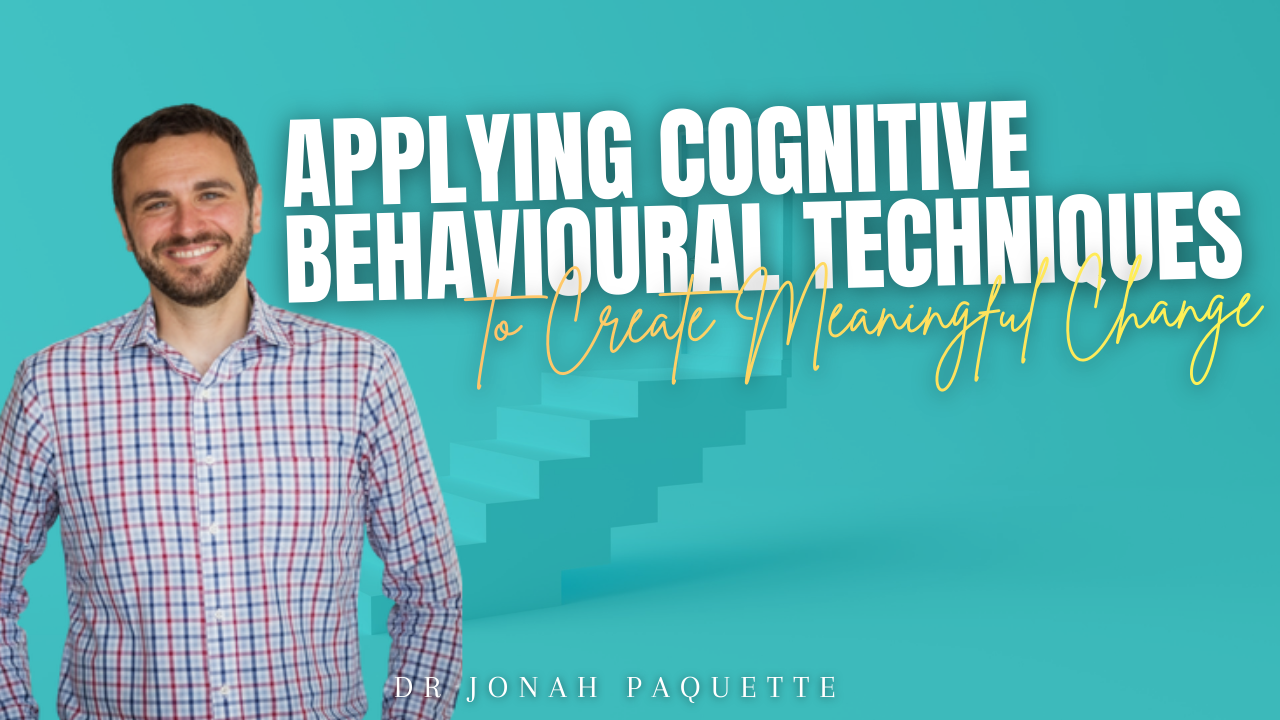
Applying Cognitive Behavioural Techniques to Create Meaningful Change

Almost every clinician has CBT somewhere in their training. The gap tends to show up later, in the session where the obvious move does not work: you have named the distortion, you have tried the balanced-thought version, and the client agrees with you intellectually and believes none of it. What you need then is another technique, and then another, and most training does not go that deep.
This course does. Jonah Paquette did his graduate training on the research team of David Burns, the author of Feeling Good, and he teaches CBT as a working toolkit rather than a model. Six hours across three parts, with the first covering the foundations and the remaining four hours spent almost entirely on technique.
He works through the cognitive distortions with the language clients actually use, then more than thirty specific methods for cognitive restructuring, including the ones that reach a client who is harder on themselves than on anyone they love. Behavioural work gets equal weight: activity monitoring, behavioural activation, pleasure prediction, and what to do with the client whose week has quietly emptied out. He covers agenda setting and the common errors that waste the first ten minutes of a session, therapeutic resistance and where it comes from, bridging between sessions so the other hundred and sixty-seven hours of the week count for something, and cognitive defusion as the alternative when restructuring is the wrong tool.
You’ll walk away with
- The cognitive distortions worked through with the phrasing clients actually bring you
- More than thirty specific techniques for cognitive restructuring, not one method repeated
- What to do when the balanced-thought approach does not land, which is most of the difficulty
- Self-compassion used as a restructuring technique, for the client who is kinder to everyone but themselves
- Agenda setting with a difficult client, and the common errors that lose the first part of a session
- Therapeutic resistance: where it comes from and how to work with it rather than against it
- Activity monitoring, behavioural activation and pleasure prediction, with when each one fits
- Bridging between sessions, and why what happens in the other hundred and sixty-seven hours matters more
- Cognitive defusion as an alternative to restructuring, and how to tell which the client needs
- Where mindfulness-based approaches complement cognitive work rather than competing with it
- How maladaptive thinking develops and holds across the lifespan, and which distortions cut across diagnoses
Watch the course trailer
CPD Information For Mental Health Professionals
Enjoy complete flexibility with 100% self-paced learning you can access anytime, anywhere, and on any device. This course is included with your Tatra Training membership, along with every other course in the library.
Where this sits: the technique-focused course in Jonah Paquette’s set, and the one that assumes you already know what CBT is. The Happiness Toolbox covers his positive psychology work.
Format: three two-hour parts, with practice and reflection built in.
Course Duration: 6 learning hours
Certificate and CPD hours: On completion you’ll receive a Certificate of Completion to support your CPD records. Your certificates are yours to keep.
Assessment: Complete a short quiz at the end (80% pass mark), which you can resit as many times as needed.
Revisit Anytime: Come back to the course as often as you like while your membership is active, whenever you want a refresher for practice.
CPD Eligibility: This program may be suitable for CPD for professionals such as:
- Psychologists
- Counsellors and Psychotherapists
- Social Workers
- Community Workers
- Mental Health Nurses
- General Practitioners (GPs)
- Occupational Therapists
CPD requirements vary between professional bodies, so please check with your association or credentialing body to confirm you can claim CPD hours/OPD points for this program and what evidence they require.
Course Content
Meet Your Instructor

Clients struggling with trauma, anxiety, and life's inevitable hardships - and organisations seeking to build genuine employee well-being rather than superficial wellness programs - can need more than traditional approaches to create lasting positive change. Jonah Paquette has dedicated his career to translating cutting-edge research from positive psychology and well-being science into practical tools that help individuals and organisations not just recover from difficulties, but actually thrive in their aftermath.
As Assistant Regional Director of Mental Health Training at Kaiser Permanente, where he helped oversee large mental health training programs spanning 20 medical centers, and co-host of "The Happy Hour" psychology podcast, Dr. Paquette represents the unique combination of clinical expertise and accessible communication that makes complex research immediately applicable. His four books - including Awestruck: How Embracing Wonder Can Make You Happier, Healthier, and More Connected and Happily Even After: Practices for Finding Well-Being After Trauma and Hardship - demonstrate his exceptional ability to distill decades of happiness research into evidence-based practices that create measurable improvements in both individual and organisational well-being.
Dr. Paquette's expertise spans positive psychology, well-being science, awe and wonder research, post-traumatic growth, anxiety disorders, PTSD treatment, CBT, resilience training, and organisational well-being. His approach recognises that true mental health goes beyond symptom reduction to encompass the cultivation of positive emotions, meaning, engagement, and connection. He specialises in helping clients and organisations move from merely surviving difficult circumstances to discovering how challenges can become catalysts for growth, meaning, and deeper well-being.
What sets his training apart is research rigor combined with practical accessibility. Paquette doesn't just teach theoretical concepts - he shows practitioners and organisations how to implement specific, evidence-based interventions that measurably increase happiness, resilience, and connection. His international keynote presentations and workshops demonstrate his exceptional ability to make complex well-being science immediately actionable for diverse audiences.
For your practice, expect to gain specific interventions from positive psychology research, tools for helping clients discover post-traumatic growth, and frameworks for integrating well-being science with traditional therapeutic approaches. His methods particularly benefit clinicians wanting to move beyond symptom-focused treatment, those working with trauma survivors, or practitioners interested in preventive and strength-based interventions.
Quick Win: Paquette's "awe walk" technique helps clients shift from rumination and anxiety to present-moment awareness and positive emotion - which can provide significant mood improvement while building long-term resilience.
Qualifications
- PsyD, Clinical Psychology, PGSP-Stanford PsyD Consortium, Palo Alto, CA (APA-accredited)
- BA, Psychology and History, Columbia University, New York
- Licensed Clinical Psychologist, California
- Over 10 years healthcare leadership experience at Kaiser Permanente
Authored Books
- Happily Even After: Practices for Finding Well-Being After Trauma and Hardship (2022)
- Awestruck: How Embracing Wonder Can Make You Happier, Healthier, and More Connected (2020)
- The Happiness Toolbox: 60+ Evidence-Based Activities for Greater Joy (2018)
- Real Happiness: Proven Paths for Contentment, Peace & Well-Being (2015)
Leadership & Training
- Assistant Regional Director, Mental Health Training, Kaiser Permanente, Northern California
- Training Director, APA-Accredited Postdoctoral Residency Program, Kaiser Permanente
- Clinical Psychologist, Kaiser Permanente, San Francisco Bay Area
- Co-host, "The Happy Hour" Psychology Podcast, current
Professional Experience
- Author & International Speaker, Keynote Presentations & Workshops, 2015–present
- Clinical Psychologist, Veterans Affairs hospitals
- Psychologist, Community mental health clinics and outpatient medical centers
- Counselor, College counseling centers
- Private Practice Clinician
Clinical Specialties
- Positive psychology and well-being science applications
- Post-traumatic growth and resilience building
- Awe, wonder, and positive emotion cultivation
- Anxiety disorders and PTSD treatment using strength-based approaches
- Cognitive Behavioral Therapy (CBT) integration with positive psychology
- Trauma therapy with focus on growth and meaning-making
- Organisational well-being and emotional fitness programs
Research & Innovation Areas
- Translation of happiness research into practical interventions
- Evidence-based activities for joy and well-being enhancement
- Integration of awe and wonder into therapeutic practice
- Resilience training for individuals and organisations
- Post-traumatic growth facilitation techniques
Ready to help clients not just recover from hardship but discover new levels of well-being and meaning? Discover how Dr. Paquette's evidence-based positive psychology methods can help transform your ability to cultivate lasting happiness, resilience, and growth in both individual and organisational settings.
Feedback & Reviews
This course includes:
- Lessons 1
- Topics 4
- Duration 6 hours
- Quizzes 2
- Language English