

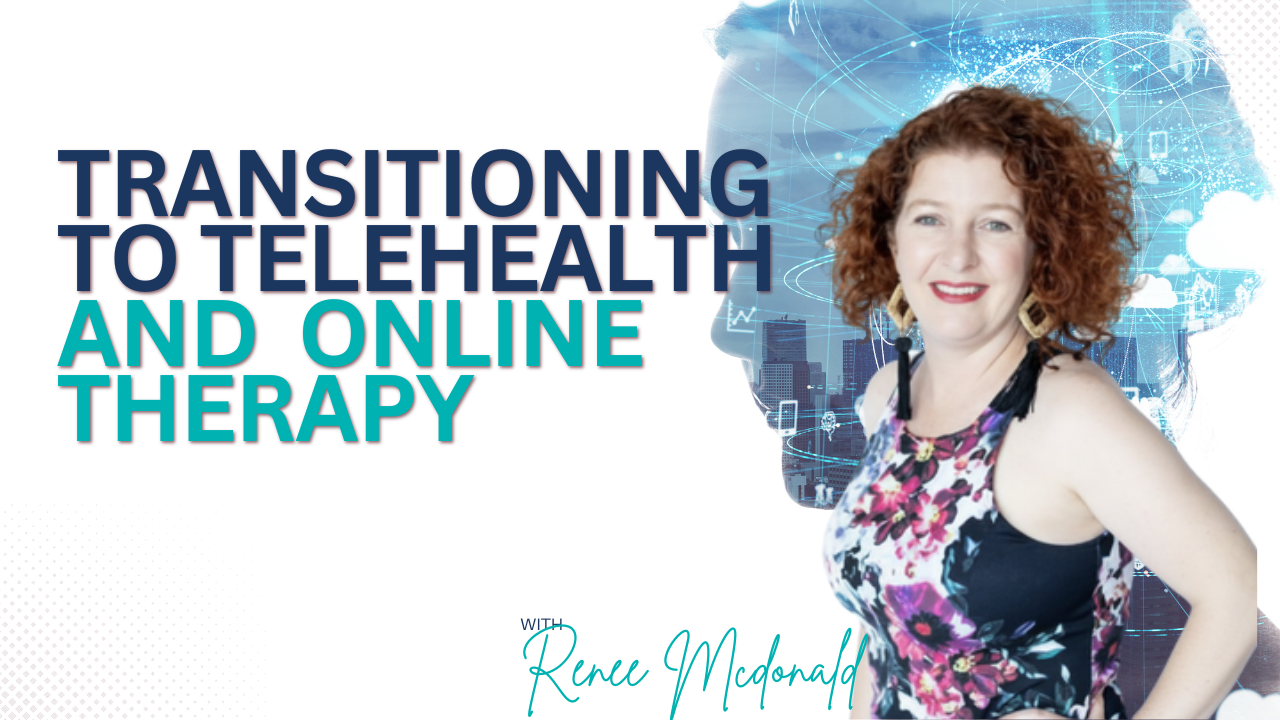
Transitioning to Telehealth and Online Therapy

CPD Pass holders
Already have an Unlimited CPD Pass?
Log in to start this course, pick up where you left off, or save it to your favourites for later.
Don't have your CPD Pass yet?
Get this course and 150+ more with an Unlimited CPD Pass
- Try all our courses free for 7 days
- Do as many of our 150+ courses as you like for 12 months, for what a single course costs
- One price covers every course. No extra fees
- Watch on desktop, TV or mobile, whenever it suits you
- New courses added regularly
- CPD certificate when you complete each course
Almost nobody was trained for this. Practices moved online quickly, people worked out what functioned, and the emergency became the arrangement. What never happened was the training, so a lot of clinicians are running online practices assembled from improvisation and whatever a colleague suggested at the time.
Renee McDonald had been working online in Australia for about fifteen years before any of that, and published a book on it in 2019. She comes at this as someone who chose the format rather than inherited it, which means she can say what the improvised version tends to leave out.
Two and a half hours across five parts, and the structure tells you what she thinks matters. Setting the scene. Geography, which is her way into jurisdiction and the questions that follow when your client is not in the same state or country. Delivering professionally online. Whether you are actually ready for online work, which is a real question rather than a rhetorical one. And boundaries online, which is where most of the trouble originates. The practical material comes with it: privacy, billing, records, booking and payment systems, and the mistakes that expose a practitioner. The course includes a handbook and a set of contracts you can adapt for your own practice.
You’ll walk away with
- Building and holding rapport through a screen, with individuals, families and groups
- Adapting in-room interventions to online delivery rather than transplanting them unchanged
- Boundaries online, which behave differently and are where most difficulty starts
- Geography and jurisdiction: what changes when your client is in another state or country
- Protecting client privacy in a format with more places for it to leak
- An honest assessment of whether you and your practice are ready for online work
- The technology set up properly once rather than patched repeatedly
- Billing, recordkeeping and getting paid for telehealth
- Booking systems and payment gateways that suit a therapy practice
- The mistakes that expose a practitioner, and how to avoid them
- A handbook and a set of contracts you can adapt and use immediately
Watch the course trailer
CPD Information For Mental Health Professionals
Enjoy complete flexibility with 100% self-paced learning you can access anytime, anywhere, and on any device. This course is included with your Tatra Unlimited CPD pass, along with every other course in the library.
Included: a handbook and a set of contracts you can adapt for your own practice.
Course Duration: 2.5 learning hours
Certificate and CPD hours: On completion you’ll receive a Certificate of Completion to support your CPD records. Your certificates are yours to keep.
Assessment: Complete a short quiz at the end (80% pass mark), which you can resit as many times as needed.
Revisit Anytime: Come back to the course as often as you like while your Unlimited CPD Pass is active, whenever you want a refresher for practice.
CPD Eligibility: This program may be suitable for CPD for professionals such as:
- Psychologists
- Counsellors and Psychotherapists
- Social Workers
- Community Workers
- Mental Health Nurses
- General Practitioners (GPs)
- Occupational Therapists
CPD requirements vary between professional bodies, so please check with your association or credentialing body to confirm you can claim CPD hours/OPD points for this program and what evidence they require.
PART 1 – Setting the Scene
- What is online therapy?
- What is Telehealth?
- What’s the difference in the types of practice when working virtually.
- What does it mean to transition?
- Working in a Post-Covid-19 world
- What’s going on with Zoom?
- What platforms are safe and secure?
- What are the necessary legal requirements when working online.
- Even if you’ve “practised online”, what more you may still be missing.
- The importance of training and where international standards come in.
- What are the limitations when working online.
- Self-care, working from home and our existential dilemmas when on lockdown.
PART 2 – The importance of geography – providing services across the local, regional & global divide
- Online disinhibition – defining what it is
- Presence, essence and the space between – what is it and how is it relevant to Telehealth practice?
- Other products of online practice
- Globalisation and its importance in the online / telehealth space
- Rurally, regionally and remotely working online
- The challenge of empathy online
- Trends – of the online working space
- Finding new clients online
- Case studies
- OAIC Australian Government notifiable data breaches – and what does that mean?
PART 3 – Solutions to providing professional online therapeutic services
- Booking and calendar systems
- Payment gateways
- Tips, tricks and pitfalls of using online therapy.
PART 4 – Are you ready for online work?
- Being ready for online work
- Online magic
- Looking at online overwhelm
- Examples of online services that you can provide
- Boundaries
- Counselling vs Coaching
- Privacy and confidentiality
- Keeping clients and yourself safe online
- Backup plans
PART 5 – Boundaries online
- Flexibility and boundaries
- Benefits and challenges of online work
- Some of the latest research and further learning, regarding online work
- Using Zoom
- Grounding
- Couple and Family Practice
- E-commerce legislation
- HIPAA compliance
- GDPR compliance
- Insurance
- Gen Y & Millennials
- Australian Government legislation and regulations for online work.
- Mandatory reporting and how it applies to the online space.
- Examples given of further information and support beyond this course.
- 10-Point Plan for DIY Telehealth / Online Therapy framework set up
Dont have your CPD Pass yet?
Start Your 7 Day Free TrialCourse Content
Meet Your Instructor

The future of mental health care is digital - but many practitioners struggle to provide effective therapy through screens, lacking the specialised training needed to create genuine connection and therapeutic presence in virtual environments. Renee McDonald has spent over 20 years pioneering online therapy in Australia, becoming one of the country's leading experts in telehealth delivery and helping thousands of practitioners transition from traditional face-to-face work to effective digital therapeutic relationships.
As Director of Australian Online Therapy Training and author of Online Therapy: Processes, Tasks, Integration and Energetic Holding (Lambert Academic Publishing, 2019, reprinted 2020), McDonald brings unparalleled expertise to the rapidly evolving field of digital mental health. Her role as Senior Professional Member and Registered International Online Clinical Supervisor with the Association for Counselling and Therapy Online (ACTO) demonstrates her leadership in establishing professional standards for online therapy delivery. As one of the first practitioners in Australia to offer specialised training in online therapy techniques, she has helped shape how an entire generation of therapists approaches digital therapeutic work.
McDonald's expertise spans online therapy and telehealth delivery, relationship counselling, grief and loss therapy, trauma and PTSD treatment, couples therapy (EFT and Gottman methods), clinical supervision, and what she calls "energetic holding" in virtual therapeutic spaces. Her approach recognises that effective online therapy requires more than simply moving in-person techniques to video calls - it demands understanding how technology affects therapeutic rapport, presence, and the subtle energetic exchanges that facilitate healing. She specialises in training practitioners to create genuine intimacy and safety through screens, working with clients across different time zones and cultures, and maintaining therapeutic boundaries in digital environments.
What sets her training apart is pioneering experience combined with practical wisdom. McDonald doesn't just teach online therapy theory - she shows practitioners exactly how to establish presence, manage technical challenges, and create the "energetic holding" that allows deep therapeutic work to happen virtually. Her integration of mindfulness practices, coaching techniques, and traditional psychotherapy creates a comprehensive framework for digital therapeutic excellence.
For your practice, expect to gain specific techniques for building rapport online, tools for managing the unique challenges of digital therapy, and frameworks for creating therapeutic presence through technology. Her approach particularly benefits practitioners transitioning to telehealth, those wanting to expand their client base internationally, or clinicians seeking to develop expertise in the growing field of digital mental health.
Quick Win: McDonald's "energetic check-in" technique helps practitioners quickly assess and adjust their virtual presence - helping to transform awkward online sessions into deeply connected therapeutic encounters that clients can find as powerful as in-person work.
Qualifications
- MAppSocSc, Applied Social Science, Australian College of Applied Psychology (ACAP), 2008
- Post-Grad Dip Couns, Counselling, Australian College of Applied Psychology (ACAP), 2002
- B Couns (Coaching), Counselling and Coaching combined degree, Australian College of Applied Psychology (ACAP), 2017–2019
- PACFA Clinical Counsellor, Psychotherapist, and Accredited Supervisor
- Senior Professional Member and Registered International Online Clinical Supervisor, ACTO
- Advanced training: EFT, Gottman Method, trauma therapy, grief therapy, mindfulness, meditation
Authored Publications
- Online Therapy: Processes, Tasks, Integration and Energetic Holding (2019, Lambert Academic Publishing, reprinted 2020, textbook based on research and practice experience in online therapy)
Professional Experience
- Workshop Facilitator & Leader, Heart & Soul Movement™, 2014–present
- Managing Partner, The Shine Counsel (podcast and partnership), July 2017–2022 (5 years)
- Online Counsellor & Therapist, Dr Julian Medical Group (UK international platform), September 2018–June 2020
- Teacher and Educator, TAFE NSW (Ultimo, Loftus, and Sydney campuses), February 2006–2013 (7 years)
- Counselling Unit Manager, Clinical Supervisor, Clinical Counsellor and Psychotherapist, Enough is Enough (Anti Violence Movement), May 2004–September 2005
- Volunteer Telephone Counsellor and Crisis Supporter, Lifeline Australia, January 2001–September 2004 (3+ years)
Clinical Specialties
- Online therapy and telehealth delivery expertise
- "Energetic holding" in virtual therapeutic spaces
- Relationship counselling and couples therapy (EFT and Gottman methods)
- Grief and loss therapy, trauma and PTSD treatment
- Clinical supervision and professional mentoring
- Mindfulness and meditation integration
- International online counselling across time zones
- Sex-positive and kink-allied therapy approaches
- Open relationships and non-monogamy counselling
"I have a love of helping people have a better life, be it through self-discovery in therapy, through creativity, spiritual practice or through educating themselves."
Ready to master the art of online therapy and expand your practice into the digital age? Discover how Renee McDonald's pioneering methods can help you create genuine therapeutic connection through screens while building a thriving international practice that serves clients anywhere in the world.
Feedback & Reviews
This course includes:
- Lessons 6
- Topics 0
- Duration 2.5 hours
- Quizzes 1
- Language English