

The Burnout Toolbox: Practical Solutions to Implement Self-Care, Increase Energy Level and Improve Well-Being

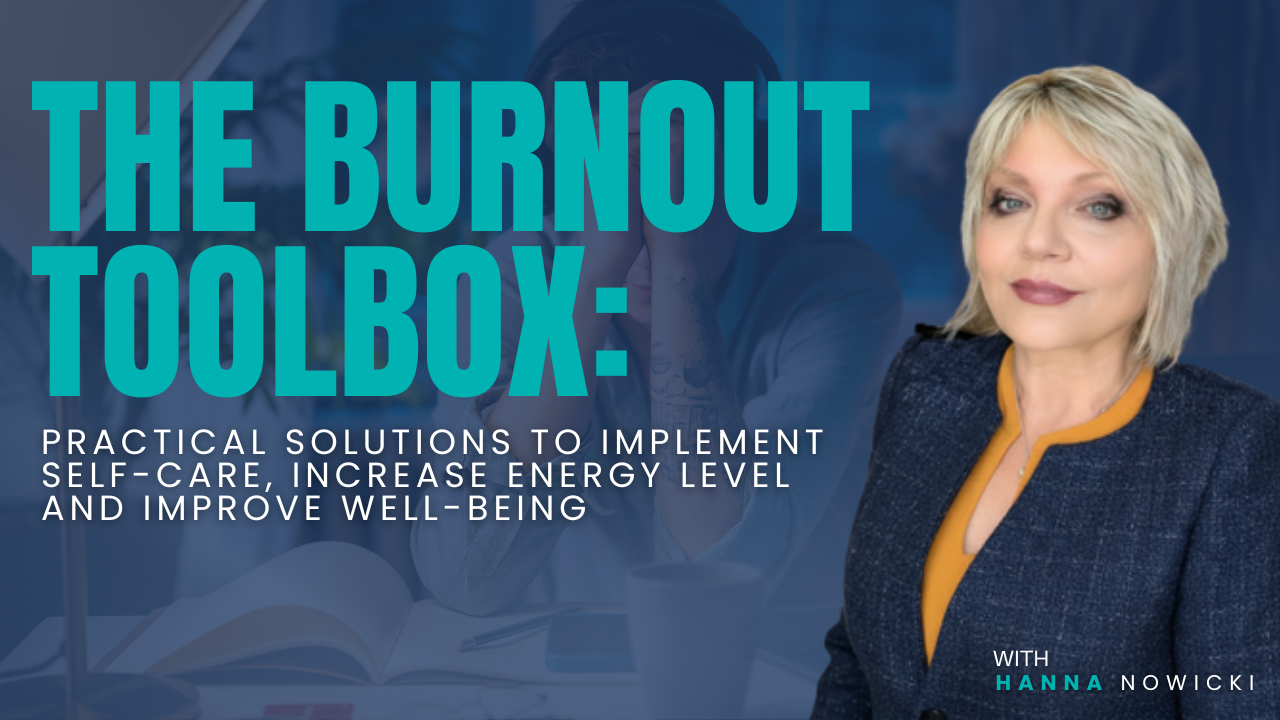
The usual response to burnout puts the problem in the person. Build resilience, practise self-care, manage your stress better. Hanna Nowicki reframes it: chronic stress and burnout are a signal that something needs to change, and advice aimed at helping someone tolerate the situation is a way of avoiding what the signal is saying.
That reframe leads somewhere specific. Six characteristics of a workplace drive most burnout, and they are features of how work is organised rather than of who is doing it. Overtime that has become normal, boundaries that stopped meaning anything, instructions from different directions that contradict each other. None of those are fixed by a mindfulness app.
Three and a half hours, the shortest course in her catalogue, and it moves quickly. She starts by separating burnout from the conditions it resembles, which matters because the treatments diverge. Then the neurobiology, including what sustained chronic stress does to the brain, since a clinician explaining this to a client needs more than sympathy. Then the practical half: lifestyle changes that actually raise energy, strategies for recovery and for prevention, and what a team leader can change about how a team works rather than how its members cope.
You’ll walk away with
- Burnout distinguished from the conditions it is mistaken for, and why the distinction changes what you do
- The dimensions of burnout, with its symptoms and signs set out
- The six workplace characteristics that produce most of it
- The neurobiology of burnout, and what chronic stress does to the brain over time
- Reinterpreting chronic stress as information rather than as a personal shortcoming
- Self-awareness as the first practical step, and how to build it in yourself and in clients
- Lifestyle changes that raise energy, including the nutritional factors worth checking
- Strategies for recovery, and separately for prevention
- What a team leader can change about how work is organised
- How to help clients prevent and manage burnout rather than only endure it
Watch the course trailer
CPD Information For Mental Health Professionals
Enjoy complete flexibility with 100% self-paced learning you can access anytime, anywhere, and on any device. This course is included with your Tatra Training membership, along with every other course in the library.
Course Duration: 3.5 learning hours
Certificate and CPD hours: On completion you’ll receive a Certificate of Completion to support your CPD records. Your certificates are yours to keep.
Assessment: Complete a short quiz at the end (80% pass mark), which you can resit as many times as needed.
Revisit Anytime: Come back to the course as often as you like while your membership is active, whenever you want a refresher for practice.
CPD Eligibility: This program may be suitable for CPD for professionals such as:
- Psychologists
- Counsellors and Psychotherapists
- Social Workers
- Community Workers
- Mental Health Nurses
- General Practitioners (GPs)
- Occupational Therapists
CPD requirements vary between professional bodies, so please check with your association or credentialing body to confirm you can claim CPD hours/OPD points for this program and what evidence they require.
Course Content
Meet Your Instructor

Frontline mental health professionals struggling with complex cases - from suicidal clients to challenging personality disorders - need more than theoretical knowledge to make real-world impact. Hanna Nowicki has spent over 30 years bridging the gap between academic concepts and practical application, becoming one of Australia's leading mental health trainers and helping over 20,000 professionals develop confidence with their most difficult cases.
As Founder of TATRA, Nowicki brings a unique combination of legal expertise, psychology training, and extensive frontline experience to her teaching. Her remarkable career journey - from District Court Judge in Poland dealing with family law to Senior Practitioner in South Australia's Statewide Suicide Intervention Program - gives her unparalleled insight into both systemic and individual approaches to mental health crisis intervention. Her multilingual abilities and multicultural practice experience add crucial cultural competency to her training programs.
Nowicki's expertise spans suicide risk assessment, personality disorders, self-injury, depression, anxiety disorders, client engagement techniques, workplace debriefing, and multicultural mental health practice. Her approach focuses on practical "know-how" rather than abstract theory, showing professionals exactly what to do and say in challenging situations. She specialises in training professionals who work with high-risk populations, including those in child protection, correctional services, and community mental health settings.
What sets her training apart is real-world credibility. Nowicki doesn't just teach from textbooks - she draws from decades of direct practice in suicide prevention, child protection, and mental health services. Her work with government organisations like Centrelink, Correctional Services, and Housing SA demonstrates her ability to translate clinical knowledge into practical strategies that work in diverse professional settings.
For your practice, expect to gain specific techniques for engaging resistant clients, practical tools for suicide risk assessment, and frameworks for working effectively with personality disorders. Her interactive, high-energy teaching style particularly benefits practitioners who need confidence-building alongside skill development.
Quick Win: Nowicki's "engagement hierarchy" technique helps professionals quickly establish rapport with defensive or hostile clients by matching their communication approach to the client's presenting style - often creating breakthrough connections in the first encounter.
Qualifications
- LLM, Law, University of Adam Mickiewicz, Poznan, Poland, 1979–1983
- Postgraduate studies: Social Psychology, Psychology of Crime, Pathological Psychology, Criminology, University of Adam Mickiewicz, Poland, 1984–1985
- BA, Psychology, Flinders University, Australia
- Postgraduate Degree, Social Administration, Flinders University, Adelaide, 1992–1994
- Certificate IV in Training & Workplace Assessment
- Accredited De-briefer and Workplace Trainer
- Multilingual (speaks four languages)
Career & Leadership
- Founder, TATRA Corporate and Allied Health Training Services
- Professional Trainer & Speaker, Mental Health Education, Australia-wide, 1996–present
- State Manager, SA Mental Health Training Centre, NSW Institute of Psychiatry, 2005–2008
- Senior Practitioner, Statewide Suicide Intervention Program, South Australia, 1996–2005
Professional Background
- District Court Judge (Family Law), Poland, 1985–1989
- Legal Practitioner, Poland, early 1980s
- Social Worker, South Australian Mental Health Services, Adelaide, 1993–1996
- Child Protection Worker
- University Lecturer, Social Policy
Specialised Expertise
- Suicide risk assessment and intervention
- Personality disorders diagnosis and management
- Self-injury and self-harming behavior
- Depression and anxiety disorders
- Client engagement techniques for difficult cases
- Workplace debriefing and crisis response
- Multicultural mental health practice
Ready to transform your confidence with challenging mental health cases? Discover how Hanna Nowicki's practice-based approach can give you the real-world skills and cultural competency needed to make a genuine difference with your most difficult clients.
Feedback & Reviews
This course includes:
- Lessons 3
- Topics 0
- Duration 3.5 hours
- Quizzes 1
- Language English