

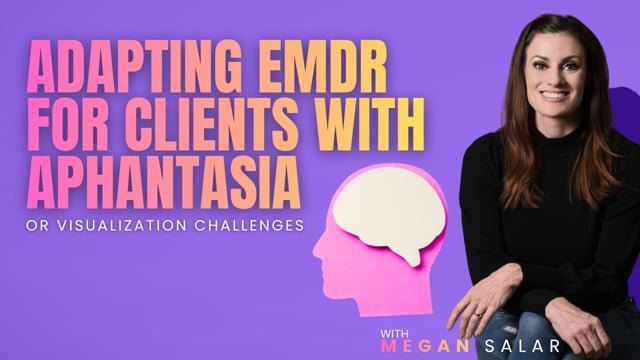
Adapting EMDR for Clients with Aphantasia or Visualization Challenges

Members
Already a Tatra member?
Log in to start this course, pick up where you left off, or save it to your favourites for later.
Not a member yet?
This course is included in Tatra membership
- Try it free for 7 days
- Learn from our entire 150+ course library for what one course costs.
- Watch on desktop, TV or mobile, whenever it suits you
- New courses added regularly
- CPD certificate when you complete each course
You ask the client to bring up an image, and they tell you there isn’t one. They close their eyes and there’s nothing there, just black. Or they recall the memory in flat, factual terms, with none of the charge you’d expect to see. If you’ve worked in EMDR for long, you’ve met this client, and you may have quietly wondered whether the model can work for them at all.
There’s a common belief that EMDR needs a client who can see the memory in their mind’s eye, and a lot of the wording in the protocol leans that way. But for the growing number of clients who can’t generate visual imagery, whether that’s aphantasia, reduced imagery, or the detachment that complex trauma can leave behind, that assumption quietly shuts the door. Many of them have tried EMDR before and come away frustrated, because the clinician kept asking them to picture something they simply cannot.
In this course, Megan Salar shows you that visualisation was never what made EMDR work. The change happens in the felt sense and the nervous system, not in the picture. She walks through how to adapt each phase when a client can’t visualise: how to screen for it early without making someone feel they’ve failed, how to read the way each client actually processes, and how to build resources and run reprocessing without leaning on imagery.
Her examples come straight from the room. The completely blind participant in one of her trainings who taught her how much a single word can shut a client down. The client whose calm place lived in the feeling of cold water and mud between his toes. The baseball mitt used as a sensory catalyst to reach a memory. The client reactive to loud sounds, and how to make that the target rather than a picture of the past. You’ll also see why auditory and tactile bilateral stimulation tend to work better here, and why calm place can backfire.
The next time a client tells you there’s nothing there, you’ll know it isn’t a dead end. You’ll know how to meet them in the senses they do have, and keep the work moving.
You’ll walk away with
- A clear understanding of aphantasia, hypophantasia and visual limitations, and why none of them rule out EMDR
- The reasons a flattened emotional response and detachment show up when accessing the past, and how to work with them rather than push through
- A way to read how each client processes, through sensation, thought or emotion, instead of relying on imagery
- A simple screening question to identify visualisation difficulty before it derails the work
- A phase one sensory intake, including a five senses exercise, to find the senses each client responds to most
- The confidence to choose auditory and tactile bilateral stimulation, and to know when calm place will backfire
- Language that keeps clients engaged, swapping “imagine” and “picture” for “notice” and “feel”
- A full set of non-visual resources: sensory catalysts, music, writing, movement, anchoring and art
- A modified phase three protocol that starts with current presenting issues and adapts targets, interweaves and pacing
- The judgement to let the work move slowly with this population while keeping a clear sense of direction
Watch the course trailer
CPD Information For Mental Health Professionals
Enjoy complete flexibility with 100% self-paced learning you can access anytime, anywhere, and on any device. Pay once for lifetime access.
Course Duration: 1 learning hour
Certificate and CPD hours: On completion you’ll receive a Certificate of Completion to support your CPD records.
Assessment: Complete a short quiz at the end (80% pass mark), which you can resit as many times as needed.
Lifetime Access: Your access to the course does not expire, so you can revisit main concepts anytime you want a refresher for practice.
CPD Eligibility: This program may be suitable for CPD for professionals such as:
- Psychologists
- Counsellors and Psychotherapists
- Social Workers
- Community Workers
- Mental Health Nurses
- General Practitioners (GPs)
- Occupational Therapists
CPD requirements vary between professional bodies, so please check with your association or credentialing body to confirm you can claim CPD hours/OPD points for this program and what evidence they require.
Not a member yet?
Start Your 7 Day Free TrialCourse Content
Meet Your Instructor

Individuals struggling with complex trauma and addiction - and the practitioners trying to help them - can find that traditional approaches sometimes fall short when addressing the deep, intertwined wounds that drive both conditions. Megan Salar has built her career around this challenging intersection, becoming an internationally recognised expert who combines evidence-based EMDR therapy with raw authenticity to create breakthrough healing experiences for both clients and the clinicians who serve them.
As an EMDR Trainer, Practitioner and published author of EMDR for Dummies (2023) and The EMDR Workbook for Trauma and PTSD (2023), and The EMDR Flip Chart (2023), Salar brings unique expertise that bridges clinical excellence with lived experience. Her previous ownership of an award-winning intensive outpatient treatment center (Best in Practice, 2019) demonstrates her ability to create effective treatment programs, while her current role as Owner/Founder of The Mental Survivalist reflects her commitment to revolutionising how we approach trauma and addiction recovery. Her training of thousands of clinicians across the United States and internationally positions her as a leading voice in trauma-informed care.
Salar's expertise spans EMDR therapy, trauma treatment, addiction counseling, PTSD treatment, anxiety disorders, clinical supervision, and what she calls "authentic healing." Her approach recognises that lasting recovery requires more than technique - it demands courage to face one's authentic self and work through the "messiness" of trauma and addiction simultaneously. She specialises in treatment-resistant cases, dual diagnosis presentations, and training clinicians who want to move beyond more surface-level interventions to create genuine transformation.
What sets her training apart is authentic vulnerability combined with clinical expertise. Salar doesn't just teach EMDR protocols - she shows practitioners how to create the authentic therapeutic relationships necessary for deep healing while managing their own emotional responses to intense trauma work. Her integration of personal recovery experience with advanced clinical training gives her unique insight into what actually creates lasting change.
For your practice, expect to gain specific EMDR techniques for addiction and trauma, tools for managing blocked processing and treatment resistance, and frameworks for building genuine therapeutic relationships with challenging clients. Her approach particularly benefits clinicians working with dual diagnosis cases, those wanting EMDR training outside traditional EMDRIA structures, or practitioners seeking to integrate authenticity and clinical excellence.
Quick Win: Salar's "authentic check-in" technique helps practitioners quickly assess their own emotional state before sessions - helping to prevent burnout while creating the genuine presence that facilitates deeper client healing and therapeutic breakthroughs.
Qualifications
- MSW, Clinical Social Work, Northwest Nazarene University 2011
- Advanced Certified Alcohol and Drug Counselor (ACADC) 2018-2022
- Certified Clinical Trauma Professional - Level II (CCTP-II) 2017-2023
- Certified EMDR Practitioner 2018
- Licensed Clinical Social Worker 2011-2023
- Registered Clinical Supervisor 2018-2023
Authored Books
- EMDR for Dummies: The Breakthrough Therapy for Overcoming Anxiety, Stress, and Trauma (2024)
- The EMDR Workbook for Trauma and PTSD: Skills to Manage Triggers, Move Beyond Traumatic Memories, and Take Back Your Life (2023)
- The EMDR Workbook for Addiction (forthcoming 2026)
- The EMDR Flip Chart (2023)
Professional Experience & Leadership
- Owner & Founder, The Mental Survivalist, 2023–present
- Owner, Recoverhe Counseling & Consulting, 2016-2023
- Certified EMDR Trainer, Independent Practice, current
- Clinical Trainer & Consultant, International
Clinical Experience
- Owner and Clinical Director, Addiction and Trauma Recovery Services, 2015–2020
- Various clinical positions in addiction prevention, intervention, treatment, and continuing care services
- Clinical supervision and training of other clinicians
Clinical Specialties
- EMDR therapy for complex trauma and addiction
- Integration of trauma and addiction treatment
- Treatment-resistant trauma presentations
- Clinical supervision and consultation
- Authentic therapeutic relationship building
- PTSD treatment and anxiety disorders
- Evidence-based trauma treatment modalities
Ready to develop authentic therapeutic relationships that create breakthrough results with complex trauma and addiction cases? Discover how Megan Salar's evidence-based yet deeply personal methods can help you integrate clinical excellence with the genuine presence that facilitates lasting healing.
Feedback & Reviews
This course includes:
- Lessons 8
- Topics 0
- Duration 1 hour
- Quizzes 1
- Language English