

ADHD and Productivity: Helping Clients Get More Done

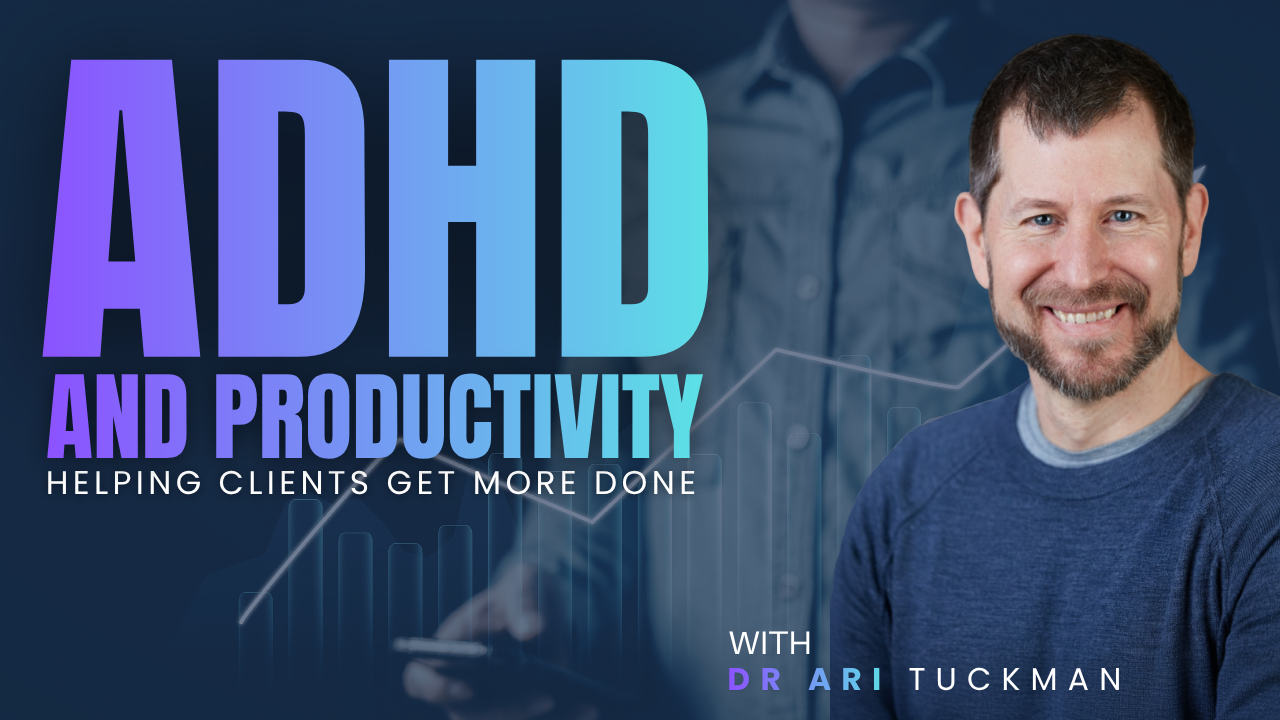
You’ve given them the system. The shared calendar, the reminders, the to-do app everyone swears by. They nod, they mean it, and a week later nothing has moved. The intention was there. The action wasn’t.
That gap is the heart of ADHD, and it’s where most productivity advice falls over. Dr Ari Tuckman calls ADHD a disorder of converting intentions into actions, and the problem is rarely that the client doesn’t know what to do. They know. Something keeps getting in the way between knowing and doing, and a better app doesn’t fix it.
This course is about what actually gets in the way: perfectionism, deadline stress, overwhelm, ambiguity, the rationalisations we all tell ourselves, and the quiet emotional weight that turns a simple to-do list into a record of everything the client didn’t do. Ari is an international ADHD expert and the author of The ADHD Productivity Manual, and this is the clinical version of that work, filmed in full.
He starts from a point most productivity material skips: therapy doesn’t change the neurology of ADHD, so you don’t treat the symptom, you treat the person. You work earlier in the chain, before the client is standing in the hard moment relying on willpower that was never going to hold. As Ari puts it, the best place to not drink is not the bar.
From there it’s practical and specific. Why soft deadlines kill motivation, and how to disappoint early when something isn’t going to get done. How “procrastivity”, the productive-looking avoidance of the harder task, keeps clients busy and stuck. How perfectionism shows up at both the front end and the back end, and how to help a client feel good enough about good enough. How something as ordinary as a to-do list gets emotionally complicated, and how to help clients sit with that discomfort so they can actually use it.
Ari also takes on the social side most courses leave out. ADHD is, in his words, the worst-kept secret: people see the missed deadlines and the lateness, and they fill in the gaps with their own story about the client’s character. You’ll work through how productive a client really needs to be, where the good enough threshold sits, and how to help them hold their own against other people’s expectations without people-pleasing their way into burnout.
It’s grounded in clinical examples throughout, and while it’s built around clients with ADHD, much of it will land with the rest of your caseload too. You’ll come away with language and strategies you can use in the very next session, and a way of thinking about productivity that helps clients add more of the good things to their life, not just dodge the next disappointment.
You’ll walk away with
- A clear way to explain ADHD as a gap between intention and action, and why willpower is the wrong thing to rely on
- A framework for working earlier in the chain, setting clients up to succeed before the hard moment arrives
- Practical ways to make to-do lists usable, including time blocking and clearing the emotional weight that builds up around them
- Help for clients to spot their favourite rationalisations, the “I’ll just remember it” lies, and talk back to them
- A way to name and interrupt procrastivity, the productive-looking avoidance of the harder task
- Strategies for deadlines: turning soft deadlines firm, using interim deadlines, and disappointing early when needed
- How to tell ADHD hyperfocus from anxiety-driven perfectionism, and help clients accept good enough
- Tools for overwhelm and ambiguity: breaking tasks down, externalising the moving parts, and getting unstuck
- A frame for the social side: how productive a client needs to be, the good enough threshold, and handling other people’s expectations
- Language and questions you can use in the next session, with much of it useful well beyond your ADHD clients
Watch the course trailer
CPD Information For Mental Health Professionals
Enjoy complete flexibility with 100% self-paced learning you can access anytime, anywhere, and on any device. Pay once for lifetime access.
Course Duration: 3 learning hours
Certificate and CPD hours: On completion you’ll receive a Certificate of Completion to support your CPD records.
Assessment: Complete a short quiz at the end (80% pass mark), which you can resit as many times as needed.
Lifetime Access: Your access to the course does not expire, so you can revisit main concepts anytime you want a refresher for practice.
CPD Eligibility: This program may be suitable for CPD for professionals such as:
- Psychologists
- Counsellors and Psychotherapists
- Social Workers
- Community Workers
- Mental Health Nurses
- General Practitioners (GPs)
- Occupational Therapists
CPD requirements vary between professional bodies, so please check with your association or credentialing body to confirm you can claim CPD hours/OPD points for this program and what evidence they require.
Course Content
Meet Your Instructor

When your adult clients with ADHD struggle to follow through on treatment plans, or when ADHD strains a couple's intimacy and communication, you need strategies that work in real-world practice. Ari Tuckman, PsyD, MBA has spent more than 25 years translating ADHD science into practical tools that help clinicians support adults, couples, and families navigating attention challenges, executive function gaps, and relationship friction.
A frequent presenter, Dr. Tuckman's teaching emphasises psychoeducation and skill-building that clinicians can apply immediately. He has delivered more than 850 presentations and podcast interviews for professionals and the public across the United States and internationally in Sweden, Turkey, Greece, Mexico, England, Spain, Denmark, Canada, and Iceland.
Dr. Tuckman is the author of five books on ADHD, including ADHD After Dark (2019) and The ADHD Productivity Manual (2025), and was inducted into the CHADD Hall of Fame in 2023 for his significant contributions to the field. He has served as conference committee co-chair for CHADD's annual International Conference on ADHD, the largest ADHD conference in the US. His work has reached audiences on CNN and National Public Radio and has been cited in The New York Times, USA Today, The Washington Post, and The Boston Globe. He contributes regularly to ADDitude Magazine and Attention Magazine, keeping the ADHD clinical community informed on emerging research and practical innovations.
In his West Chester, Pennsylvania, private practice, Dr. Tuckman works with teens and adults living with ADHD, as well as couples and families affected by attention and executive function challenges. His clinical focus spans ADHD diagnosis and treatment, executive function coaching, couples therapy, and sex therapy — including how ADHD shapes intimacy, desire, and relationship dynamics. His approach is grounded in helping clients understand their brains first, then build systems that match how ADHD brains actually work, rather than fighting against them.
Whether you're refining your assessment protocols, coaching clients on productivity, or helping couples navigate ADHD-related conflict, Dr. Tuckman's frameworks offer clear, evidence-informed steps you can teach and adapt.
For clinicians, his courses and materials provide concrete intervention strategies, language for psychoeducation, and tools to address the executive function deficits that undermine treatment gains. You'll learn how to support clients in managing time, organising tasks, sustaining attention, and regulating emotions — and how to help couples repair trust and intimacy when one or both partners have ADHD.
Qualifications
- Doctor of Psychology (PsyD)
- Master of Business Administration (MBA)
- Licensed psychologist in private practice
Selected Books
- The ADHD Productivity Manual (2025)
- ADHD After Dark: Better Sex Life, Better Relationship (2019)
- Understand Your Brain, Get More Done: The ADHD Executive Functions Workbook (2012)
- More Attention, Less Deficit: Success Strategies for Adults with ADHD (2009)
- Integrative Treatment for Adult ADHD: A Practical, Easy-to-Use Guide for Clinicians (2007)
Teaching & Roles
- Conference committee co-chair, CHADD International Conference on ADHD
- Former board member, CHADD
- Former vice president, Attention Deficit Disorder Association (ADDA)
- Frequent international speaker (850+ presentations and podcast interviews across nine countries)
- Faculty, Coach Approach Training Institute
Feedback & Reviews
This course includes:
- Lessons 4
- Topics 11
- Duration 3 hours
- Quizzes 1
- Language English