

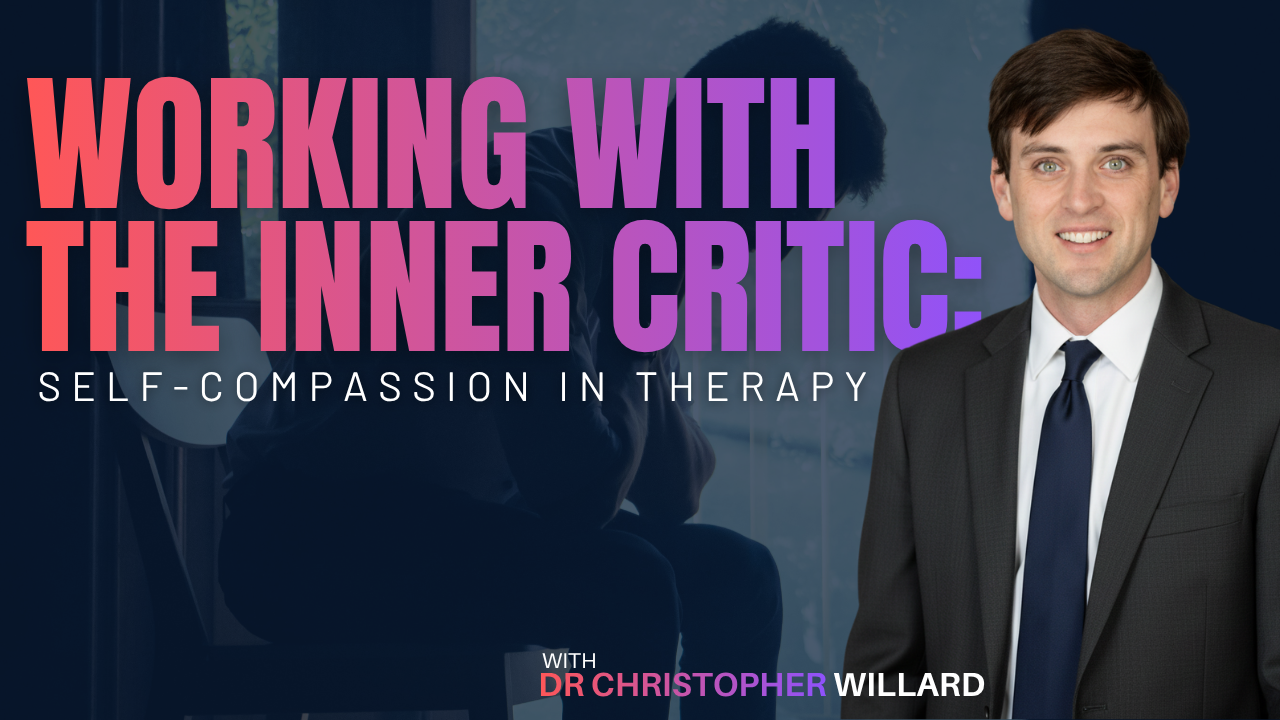
Working With the Inner Critic: Self-Compassion in Therapy
You suggest to a client that they try being a little kinder to themselves. They say the words, and something in them tightens. Telling yourself you are strong when you do not believe you are strong does not work as encouragement, and the reason is not that the client did not try hard enough.
Chris Willard’s point is that a fake affirmation registers the way any other untruth does, and it lands accordingly. The change he teaches is one word wide and it alters the whole practice: not “I forgive myself” but “may I forgive myself”. An intention instead of a claim. Nothing for the client to disprove, and a door left open. Most of what makes self-compassion work or fail in session turns on small differences like that one.
Four and a half hours treating self-compassion as a clinical tool rather than a temperament. What it is, in three parts, and what it is not. The objections that come up first, particularly from sceptical clients, and the research that answers each one. Guided practices you do alongside the recording, so you are teaching from experience rather than reading a script at someone. And the part most trainings leave out, which is where to slow down: the contraindications, and what to do when opening this with a trauma client brings up more than they can hold.
You’ll walk away with
- The reason affirmations backfire, and the shift from a claim to an intention that makes the same words land
- The self-compassion break in a form you can guide a client through in session, in about three minutes
- Answers to the four objections clients raise first, that this is self-indulgent, weakening, selfish, or will destroy their motivation, each with the evidence behind it
- The difference between self-compassion and self-esteem, and why the second is more fragile than it looks
- The contraindications, and what to do when a practice opens something a client is not yet able to hold
- A way to find language that sounds authentic to a particular client, built from their attachment history rather than from a handout
- The distinction between self-care and self-indulgence, which is the thing most clients have confused
- A way to introduce this to a sceptical client without the practice sounding soft
- Methods for folding self-compassion into DBT, ACT, MBSR and MBCT rather than running it as a separate thing
- Practices for your own compassion fatigue and secondary trauma, on the grounds that this is not teachable from a script
Watch the course trailer
CPD Information For Mental Health Professionals
Enjoy complete flexibility with 100% self-paced learning you can access anytime, anywhere, and on any device. This course is included with your Tatra Training membership, along with every other course in the library.
Course Duration: 4.5 learning hours
Certificate and CPD hours: On completion you’ll receive a Certificate of Completion to support your CPD records. Your certificates are yours to keep.
Assessment: Complete a short quiz at the end (80% pass mark), which you can resit as many times as needed.
Revisit Anytime: Come back to the course as often as you like while your membership is active, whenever you want a refresher for practice.
CPD Eligibility: This program may be suitable for CPD for professionals such as:
- Psychologists
- Counsellors and Psychotherapists
- Social Workers
- Community Workers
- Mental Health Nurses
- General Practitioners (GPs)
- Occupational Therapists
CPD requirements vary between professional bodies, so please check with your association or credentialing body to confirm you can claim CPD hours/OPD points for this program and what evidence they require.
Course Content
Meet Your Instructor
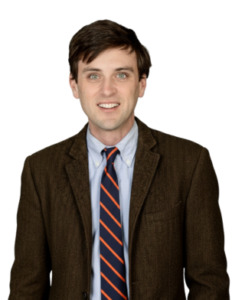
Anxious teens, stressed college students, and overwhelmed families struggling with modern pressures need more than traditional therapy approaches - they need clinicians who understand how mindfulness and other neuroscience backed practices can rewire young brains for resilience. Christopher Willard has dedicated his career to making mindfulness accessible and practical, becoming one of the world's leading experts in mindful approaches to youth mental health.
As a Lecturer on Psychiatry at Harvard Medical School, Dr. Willard has visited and trained practitioners across 44 countries in resilience, mental health, emotional intelligence, communication and more. His 20+ books - including Growing Up Mindful, College Mental Health 101, and the upcoming Neuroscience of Negotiation - have been translated into over a dozen languages and earned praise from mindfulness leaders like Thich Nhat Hanh, Tara Brach, Dan Siegel, and Jack Kornfield. His work bridges ancient wisdom with contemporary neuroscience, showing clinicians how contemplative practices can address anxiety, depression, and stress-related disorders for all ages
Dr. Willard's expertise spans mindfulness-based interventions, developmental neuroscience and corporate and educational consulting. His approach combines 20 years of personal meditation practice with rigorous clinical training, giving him unique insight into resilience across the lifespan. He helps clinicians understand when mindfulness is appropriate, how to adapt practices for different challenges, and ways to integrate contemplative approaches with evidence-based therapies.
What sets his training apart is developmental sophistication and practicality. Willard doesn't just water down mindfulness but make it relevant culturally, cognitively and developmentally for a multitasking world. His work from corporations to clinics to classrooms have shown him what interventions succeed or fail in different settings.
For your practice, expect to gain age-appropriate mindfulness techniques, practical tools for treating anxious and depressed youth, and frameworks for integrating contemplative practices with traditional therapy. His methods particularly benefit clinicians working with adolescents, college students, or families seeking alternatives to medication-focused treatment.
Quick Win: Willard's "Alphabreaths" technique gives young clients 26 different breathing practices they can choose from based on their current emotional state - creating immediate buy-in and personalised coping tools they actually use.
Qualifications
- PsyD, Clinical Psychology, Massachusetts School of Professional Psychology, 2008
- B.A., English, Wesleyan University, 2001
- Licensed Psychologist (Massachusetts)
- 20+ years of personal meditation practice
Authored Books
- College Mental Health 101 (2025, co-author with Blaise Aguirre & Chelsie Green, New Harbinger)
- How We Grow Through What We Go Through (2022, Sounds True)
- Alphabreaths (2019, Sounds True)
- Raising Resilience (2017, Sounds True, praised by Sharon Salzberg, Tina Bryson)
- Growing Up Mindful (2016, Sounds True, praised by Tara Brach, Jack Kornfield)
- Child's Mind (2010, Parallax Press, praised by Thich Nhat Hanh)
- 20+ total titles including therapeutic games and card sets, translated into 10+ languages
Teaching & Roles
- Lecturer on Psychiatry, Harvard Medical School, 2014–present
- Clinical Instructor, Cambridge Health Alliance Department of Psychiatry, 2014–present
- President, Mindfulness in Education Network, 2015–present
- Psychologist & Consultant, Enlightened Livelihoods, 2005–present
- Psychologist, Tufts University Counseling and Mental Health Services, 2009–2014
Speaking & Training
- Harvard Medical School faculty presentations
- Brahm Centre Singapore keynote (2020)
- International mindfulness training and consultation
Ready to help young people develop lifelong resilience skills? Discover how Dr. Willard's mindfulness-based methods can transform your work with anxious and stressed youth while enhancing your own clinical presence.
Feedback & Reviews
This course includes:
- Lessons 15
- Topics 0
- Duration 4.5 hours
- Quizzes 1
- Language English