

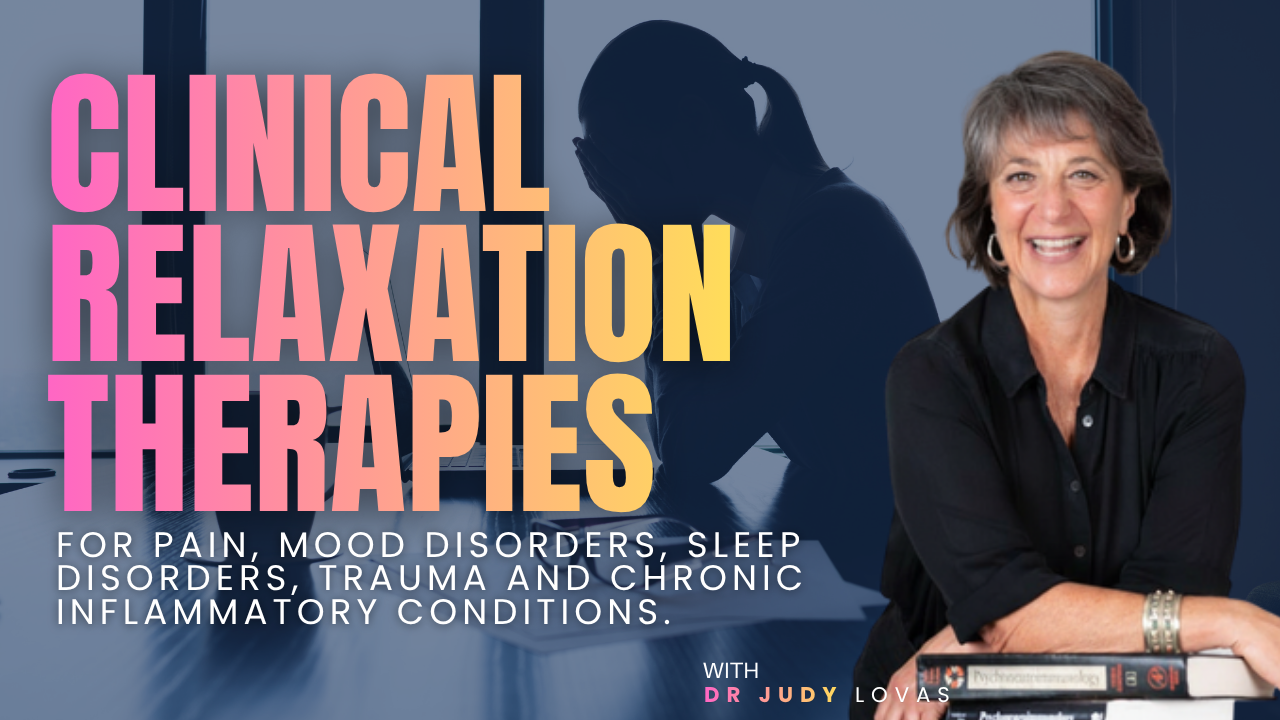
Clinical Relaxation Therapies for Pain, Mood Disorders, Sleep Disorders, Trauma and Chronic Inflammatory Conditions

Members
Already a Tatra member?
Log in to start this course, pick up where you left off, or save it to your favourites for later.
Not a member yet?
This course is included in Tatra membership
- Try it free for 7 days
- Learn from our entire 150+ course library for what one course costs.
- Watch on desktop, TV or mobile, whenever it suits you
- New courses added regularly
- CPD certificate when you complete each course
A distressed client sits across from you. Their pain won’t settle, they’re not sleeping, their mood is sliding, and stress is feeding all of it. You can see it. The question is what you actually send them home with, before they walk out the door and you don’t see them for another week.
For a lot of practitioners, the honest answer is “not much”. You suggest they try to relax, or breathe, or download an app. It’s vague, it’s easy to ignore, and it leaves the client carrying their distress alone between sessions, which is exactly when they need support the most. Over time that shows up as slower progress, more relapse, and clients who feel like nothing is in their control.
That gap is what this course closes. Dr Judy Lovas has spent decades teaching two relaxation therapies clients can use on their own, anywhere, for the rest of their lives: diaphragmatic breathing and guided imagery. This is the online version of her one-day professional workshop, filmed in full.
The science is the part most of us were never taught. Psychoneuroimmunology shows the mind and body aren’t just linked, they work as one system at a cellular level. That’s why chronic distress doesn’t stay in the head. It drives pain, mood disorders, poor sleep and inflammation. Once you can explain that to a client in plain language, relaxation stops sounding like a soft add-on and starts sounding like treatment, which is what gets people to actually do it.
From there it’s practical. You’ll learn why “slow breathing” works where “deep breathing” backfires, how the diaphragm and vagal nerve switch on the body’s calming response, and how to write and deliver a script that holds a client’s focus without a wasted word. You’ll watch Judy guide live breathing and imagery sessions, then break down exactly what she did and why, including how she handles trauma, paradoxical arousal, low blood pressure and the client who says this “isn’t their thing”.
The guided imagery work is just as usable. You’ll see how to externalise a client’s pain as an object and soften it, how to build sleep imagery from their own ideal conditions, and the one rule Judy never breaks: you never put a word into a script the client hasn’t given you first.
What your clients walk away with is control: a skill they own, that costs nothing, has no side effects, and works at 2am when you’re not in the room. What you walk away with is something concrete to offer in almost any session, whatever your modality, backed by evidence and recognised by Medicare as a Focused Psychological Strategy.
You’ll walk away with
- A clear, plain-language way to explain stress, distress and the mind-body link to any client
- Confidence teaching diaphragmatic breathing, including the language that works and the words to avoid
- A repeatable framework, the why, how and when, for introducing any relaxation technique
- The ability to write and deliver a tight breathing or imagery script in your own voice
- Guided imagery techniques for pain, anxiety, sleep and chronic conditions
- A safe approach to trauma, contraindications and paradoxical arousal
- Practical ways to build compliance, from phone reminders to “one slow breath is better than none”
- An understanding of the psychoneuroimmunology evidence base, including the vagal nerve and anti-inflammatory pathways
- Case-history questions that surface a client’s distress and their existing relaxation habits
- Two lifelong self-regulation skills you can use yourself and teach with authenticity
Watch the course trailer
CPD Information For Mental Health Professionals
Enjoy complete flexibility with 100% self-paced learning you can access anytime, anywhere, and on any device. Pay once for lifetime access.
Course Duration: 6 learning hours
Certificate and CPD hours: On completion you’ll receive a Certificate of Completion to support your CPD records.
Assessment: Complete a short quiz at the end (80% pass mark), which you can resit as many times as needed.
Lifetime Access: Your access to the course does not expire, so you can revisit main concepts anytime you want a refresher for practice.
CPD Eligibility: This program may be suitable for CPD for professionals such as:
- Psychologists
- Counsellors and Psychotherapists
- Social Workers
- Community Workers
- Mental Health Nurses
- General Practitioners (GPs)
- Occupational Therapists
CPD requirements vary between professional bodies, so please check with your association or credentialing body to confirm you can claim CPD hours/OPD points for this program and what evidence they require.
Not a member yet?
Start Your 7 Day Free TrialCourse Content
Meet Your Instructor

Dr Judy Lovas is Australia’s expert in Relaxation Therapy and an international speaker, dedicated to teaching evidence-based relaxation skills for chronic conditions. Judy is determined to increase relaxation therapies in 21st century health care.
With up-to-date knowledge, passion and humour, Judy teaches medical and health professionals leading research in relaxation therapy to enhance mental health and physical wellbeing. Her presentations include how to practice simple relaxation skills and the clinical application of relaxation therapy to enhance your clients’ health.
Judy’s work is based on Psychoneuroimmunology (PNI), the science of mind body connections. She presents the latest, cutting-edge studies that support diaphragmatic breathing, guided imagery, progress muscle relaxation and massage therapy for chronic conditions such as anxiety, depression, pain, sleep disorders, trauma and inflammation.
As Director of Art & Science of Relaxation, Judy presents for prestigious institutions including the University of Sydney, Australian Psychology Society and the Australian Association of Social Work. She is an international presenter and worked with the University of Thessaly in Greece, the Sports Group GmbH in Germany and the Hebrew University in Israel. Her work is recognised in Lifestyle and Integrative Medicine organisations.
Her Ph.D. from the University of Sydney Faculty of Medicine, focused on psychological and immunological outcomes of massage therapy for spinal cord injury patients, and demonstrates her commitment to understanding the complex mind-body connections that drive healing.
Judy’s expertise in PNI-based Relaxation Therapy for chronic conditions offers measurable changes in immune function, inflammatory markers, and neurological processes to support better health. She specialises in helping practitioners understand exactly how relaxation therapies affect cellular and molecular health, why certain techniques work better than others, and how to prescribe specific relaxation interventions for different conditions and populations.
What sets Dr Lovas apart is how she translates complex science into simple concepts. Judy combines scientific rigor with practical accessibility. She doesn't just teach relaxation techniques - she shows practitioners the underlying psychoneuroimmunology mechanisms that explain why these interventions work, enabling them to make evidence-based treatment decisions. Her 18 publications and extensive teaching experience demonstrate her exceptional ability to make complex immunological and neurological concepts immediately relevant to clinical practice.
For your practice, expect to gain specific, evidence-based relaxation protocols for different conditions and frameworks for integrating PNI principles into existing treatment approaches. Judy’s approach particularly benefits healthcare professionals working with chronic conditions, those seeking non-pharmaceutical interventions, or practitioners wanting to understand the science behind mind-body healing.
Quick Win: Judy's ‘Slow Breathing’ technique helps clients quickly activate the parasympathetic nervous system while reducing inflammatory markers - often leading to measurable stress reduction while building long-term resilience through regular practice.
Qualifications
- Ph.D., Medicine, University of Sydney (dissertation: "The effects of massage therapy on secondary conditions of people with spinal cord injury: psychological and immunological outcomes")
- Master of Science Research Degree Faculty of Science Univ of Technology, Sydney, 1998
- BA, Psychology, University of New South Wales (UNSW), 1982
- Diploma, Adult Education, University of Technology Sydney (UTS), 1991
- Over 25 years experience in psychology and psychoneuroimmunology
Authored Publications
- Author and co-author of 17 publications on psychoneuroimmunology, research-based benefits of relaxation therapy, and chronic pain management
- YouTube educational content creator
- Featured on The GP Show podcast
- Regular media contributor on relaxation therapy and PNI topics
Leadership & Teaching
- Director, Art & Science of Relaxation, Sydney, 2014–present
- Lecturer, Psychology, Australian College of Physical Education, Sydney, 2019–present
- Lecturer, Cellular Health, Psychoneuroimmunology, Evidence-based Relaxation Therapy, Nature Care College, Sydney, 2016–present
- Clinical Relaxation Therapist, Cingulum Health, Sydney, 2022–present (specialising in relaxation therapy for neurological rehabilitation patients)
- Relaxation Therapy Classes Instructor, Osana Medical Centres, Cremorne & Narrabeen, Sydney, 2019–2020
Academic Experience
- Lecturer/Tutor, Psychology, Australian Catholic University, Strathfield, Sydney, 2008–2014 (Education Psychology, Developmental Psychology, Motivation and Emotion, Critical Thinking)
- Lecturer, Psychoneuroimmunology, School of Medical Science, University of Sydney
- Lecturer, Psychoneuroimmunology, Australian College of Applied Psychology
- Psychology Teacher, Methodist's Ladies College
- Lecturer, TAFE NSW, Meadowbank College of TAFE, 1989–1998 (developed Diploma in Health Science - Massage Therapy)
Clinical & Research Focus
- Psychoneuroimmunology (PNI) research and application
- Evidence-based relaxation therapy protocols
- Chronic pain management through mind-body interventions
- Anxiety, depression, and sleep disorders treatment
- Trauma therapy using relaxation techniques
- Inflammation reduction and cellular health optimisation
- Mind-body connections in healing and recovery
Community & Volunteer Work
- Volunteer Coordinator, North Sydney Persistent Pain Mental Health Network, current
- Dedicated advocate for integrating relaxation therapies into healthcare systems
- Community educator on stress management and holistic health approaches
Ready to understand the science behind why relaxation therapy creates real physiological changes? Discover how evidence-based psychoneuroimmunology can help you apply specific relaxation interventions for measurable improvements in chronic conditions.
Feedback & Reviews
This course includes:
- Lessons 5
- Topics 18
- Duration 6 hours
- Quizzes 1
- Language English