

Mastering Crises, Tough Moments and Difficult Dynamics in Psychotherapy

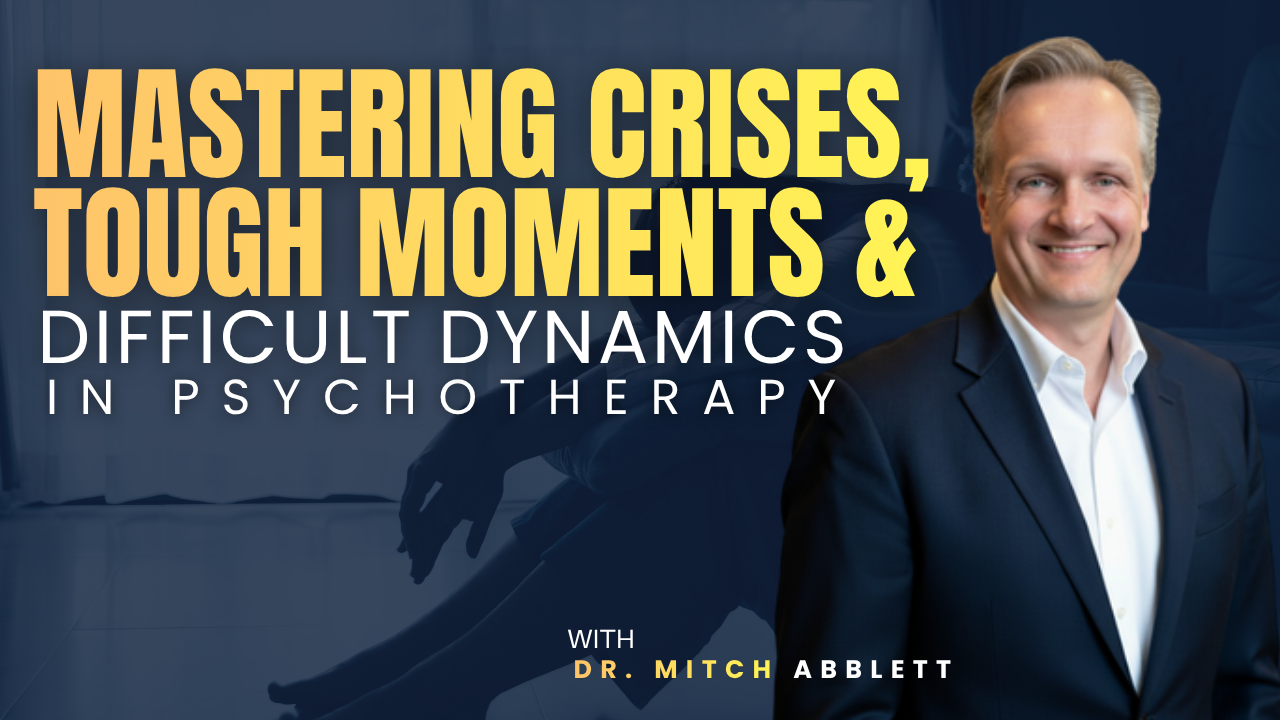
In his first years as clinical director of a therapeutic school, Mitch Abblett sent children to hospital by ambulance at a much higher rate than the same school recorded later. Same building, same kids, same behaviour walking through the door. What changed was not the caseload. It was him, and he is direct about why. He was flooded, and it was all about him.
The distinction he works from came out of his crisis intervention supervision years ago. A crisis is a gap between what a person can cope with and what they are being asked to cope with. An emergency is an imminent threat that has to be contained. Two different things, two different responses. His argument is that for most clinicians those two circles overlap far more than they should, and the overlap is made almost entirely of the clinician’s own reactivity. You cannot see the difference clearly while your own system is going off.
Four hours on the part of the work almost nobody was trained in: what happens in you when a client spits, refuses, mocks, threatens or shuts down, and what to do with it in the second or two you actually have. He covers mapping your own habit loops, the difference between empathy and compassion and why the first one burns you out, anchoring your attention mid-session so you can think again, and a way of speaking plainly to a client in the middle of it that is neither reflective listening nor a script. He is candid that he is not offering content expertise in suicidality, psychosis or personality disorder, and says so early.
You’ll walk away with
- A working line between a crisis and an emergency, and an honest look at how often the clinician’s own state is what moves a client from one to the other
- Habit loop mapping applied to yourself: the trigger, the body reaction, what you then think and do, and what that result quietly gives you
- The distinction between empathy and compassion, and why the empathic responding you were praised for in training is also what sets up secondary trauma
- A way of naming what is happening in you, out loud and in the room, that opens the conversation rather than making it about you
- Two attention moves for mid-session, one to anchor yourself when you are flooded and one to widen back out to what sits behind the behaviour, and how to move between them
- A clear read on the clients he calls empathy hard, the ones who swear and refuse and get under your skin, and why they draw the least warmth and need the most
- Holding the treatment plan and the diagnosis lightly enough that you can still see what is actually happening in front of you
- The evidence against cathartic release, and why telling an agitated client to go and hit something rehearses the behaviour rather than discharging it
- “I don’t work with that population” reframed as “I don’t like how it makes me feel”, and what that narrowing costs you over a career
- A worked role play with a mandated, hostile client who wants a letter instead of therapy, including the responses that fail and the one that lands
Watch the course trailer
CPD Information For Mental Health Professionals
Enjoy complete flexibility with 100% self-paced learning you can access anytime, anywhere, and on any device. This course is included with your Tatra Training membership, along with every other course in the library.
Course Duration: 4 learning hours
Certificate and CPD hours: On completion you’ll receive a Certificate of Completion to support your CPD records. Your certificates are yours to keep.
Assessment: Complete a short quiz at the end (80% pass mark), which you can resit as many times as needed.
Revisit Anytime: Come back to the course as often as you like while your membership is active, whenever you want a refresher for practice.
CPD Eligibility: This program may be suitable for CPD for professionals such as:
- Psychologists
- Counsellors and Psychotherapists
- Social Workers
- Community Workers
- Mental Health Nurses
- General Practitioners (GPs)
- Occupational Therapists
CPD requirements vary between professional bodies, so please check with your association or credentialing body to confirm you can claim CPD hours/OPD points for this program and what evidence they require.
- Define and understand skillful intervention skills for assessing the most challenging clinical conversations and knowing when and how to intervene effectively.
- Identify the methods for defusing and effectively managing difficult therapeutic interactions and model how to do so for others
- Learn evidence-supported techniques for improving your psychological flexibility across all the clients in your caseload.
- Learn brain and systems-based methods for addressing difficult clinical interactions, crisis situations and demonstrate skills for understanding of the skills of “moment ownership.”
Course Content
Meet Your Instructor

Individuals caught in reactive patterns that sabotage their relationships, leadership, and personal growth - and the families, teams, and organisations trying to break these destructive cycles - can need more than traditional therapeutic approaches to create lasting transformation. Mitch Abblett has spent over two decades developing "Momentology," a revolutionary framework that helps people shift from reactive autopilot to intentional, unselfish living by learning to "own their moments" when it matters most.
As a clinical psychologist, Nautilus Award-winning author, and former Executive Director of the Institute for Meditation and Psychotherapy, Dr. Abblett brings unique expertise that bridges mindfulness science with practical behavioral change. His gold medal-winning book Prizeworthy: How to Meaningfully Connect, Build Character, and Unlock the Potential of Every Child demonstrates his exceptional ability to translate complex psychological concepts into immediately applicable strategies. His 11-year tenure as Clinical Director at Harvard-affiliated Judge Baker Children's Center, working with at-risk youth and families, gives him deep understanding of how to create breakthrough moments even in the most challenging circumstances.
Abblett's expertise spans mindfulness-based therapy, child and adolescent psychology, family therapy, leadership coaching, anxiety treatment, anger management, and what he calls "Momentology" - the art and science of owning life's biggest and smallest moments. His approach recognises that lasting change happens not through lengthy analysis but through learning to show up differently in critical moments when reactive patterns typically take over. He specialises in helping clients, families, and teams break free from destructive communication patterns, develop emotional regulation under pressure, and create the authentic connections that drive both personal fulfillment and professional success.
What sets his training apart is practical wisdom combined with scientific rigor. Abblett doesn't just teach mindfulness techniques - he shows people exactly how to apply "Momentology" principles during heated conflicts, high-stakes presentations, parenting crises, and leadership challenges. His integration of meditation practice, behavioral science, and real-world application creates frameworks that work under pressure, not just in calm moments.
For your practice, expect to gain specific "moment ownership" techniques for difficult therapeutic situations, tools for helping clients break reactive patterns, and frameworks for integrating mindfulness with evidence-based therapy approaches. His methods particularly benefit clinicians working with families in crisis, those treating anxiety and anger issues, or practitioners wanting to develop authentic presence in challenging therapeutic moments.
Quick Win: Abblett's "OWN" technique (Observe what's happening, Welcome the experience without judgment, Navigate with intention) helps clients shift from reactive to responsive mode - helping to transform conflict situations into connection opportunities.
Qualifications
- Ph.D., Clinical Psychology, Florida State University, Tallahassee, FL, 1993–2001
- Licensed Clinical Psychologist, Massachusetts
- Over 20 years clinical experience in Boston area
- Former Executive Director, Institute for Meditation and Psychotherapy
Authored Books
- Prizeworthy: How to Meaningfully Connect, Build Character, and Unlock the Potential of Every Child (Nautilus Book Award Gold Medal Winner)
- The Five Hurdles to Happiness and the Mindful Path to Overcoming Them
- Helping Your Angry Teen
- From Anger to Action
- Train Your Mind Like a Ninja: 30 Secret Skills for Fun, Focus, and Resilience (Mom's Choice Awards® Gold Recipient, National Parenting Product Award Winner)
- The Heat of the Moment in Treatment (for clinicians)
- Mindfulness for Teen Depression (co-author with Chris Willard)
- The Unwinding Anxiety Deck (co-author with Dr. Judson Brewer)
Professional Experience
- Speaker, Author, Consultant & Private Practice Psychologist, Mitch Abblett PhD LLC, Wellesley Hills, MA, July 2015–present
- Executive Director, Institute for Meditation and Psychotherapy, May 2016–December 2017
- Clinical Director, Manville School at Judge Baker Children's Center (Harvard Medical School-affiliated), Boston, MA, August 2005–June 2016 (11 years)
Clinical Specialties
- "Momentology" framework for owning critical moments
- Mindfulness-based therapy and intervention
- Child and adolescent psychology and family therapy
- Anxiety and anger management treatment
- Leadership coaching and organisational consultation
- Present moment awareness and emotional regulation
- Communication skills and relationship transformation
Training Focus
- Converting crisis into opportunities for client progress
- Managing difficult therapeutic interactions through "moment ownership"
- Mindfulness-based and ACT-based methods for clinical challenges
- Moving from reactive patterns to intentional, unselfish living
- Building authentic presence in high-pressure situations
Ready to help clients transform their most challenging moments into opportunities for growth and connection? Discover how Dr. Abblett's "Momentology" methods can give you the tools to create breakthrough change when reactive patterns typically take over, turning crisis into connection for lasting transformation.
Feedback & Reviews
This course includes:
- Lessons 4
- Topics 0
- Duration 4 hours
- Quizzes 1
- Language English