

Suicide Assessment and Safety Planning

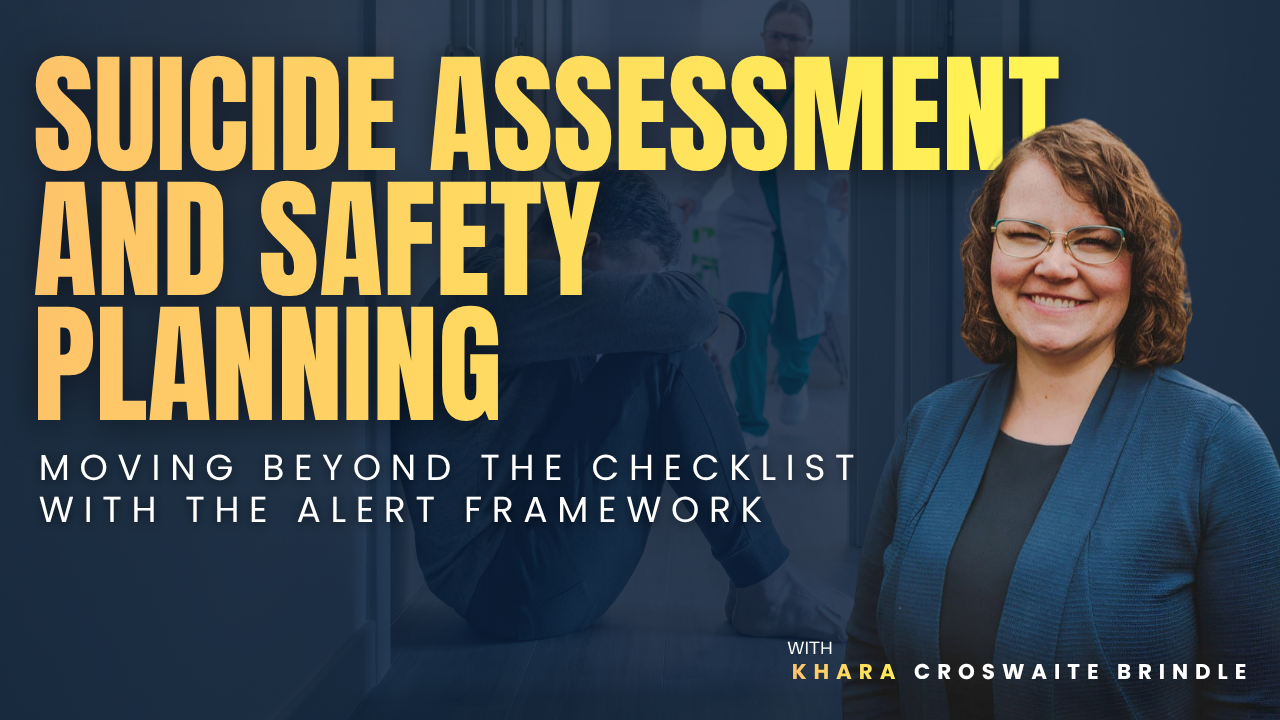
You know the moment. A client you’ve seen twice walks in curled over, arms wrapped around a cushion, barely making eye contact. Your gut says something has shifted. You know you need to ask about suicide, and you can feel your heart rate climb before the words are out.
Most practitioners had an hour or two of suicide training in their degree. Then we’re expected to be the person a client turns to when they say, “I’m not safe.” So we lean on a checklist. Thoughts, plan, means, intent. Tick, tick, tick. It covers us on paper, but it rarely tells us why this person is here, what the pain means to them, or what is keeping them alive.
Clients notice. Many hide suicidal thoughts because they fear being hospitalised. If we look uneasy, lower our voice on the word or rush to the next question, they hold back.
In this course, suicide assessment trainer and clinician survivor Khara Croswaite Brindle takes you through ALERT, the framework she has taught clinicians since 2017: Ask, Listen, Engage, Respond and Tasks. You’ll follow one client, Amy, from a distressed third session to a safety plan she helped write. Along the way you’ll learn the questions that open up the suicide story. What do you see when you think about suicide? What does it mean for you? What percentage of you wants to live?
Then you’ll see it in practice. Khara demonstrates a full intake, builds a safety plan in a role-play, and shows what to do when a client freezes or doesn’t trust you yet. The course closes with the part most training skips: what this work does to us. You’ll explore countertransference hate with chronically suicidal clients, and how to support a colleague after a client dies by suicide.
You’ll come away with direct questions you can ask in your own words, a safety planning process clients will engage with, and steadier footing when the conversation turns to suicide.
You’ll walk away with
- A compassionate, conversational way to ask directly about suicide, and why “Do you want to hurt yourself?” can miss the answer
- Follow-up questions on frequency, duration and controllability, plus what the client sees and what suicide means to them
- A clearer read on risk, including the five diagnoses most linked to suicide and the part sleep disruption plays
- How stressors, burden, isolation and Joiner’s capacity for suicide add to risk, and how to explore protective factors without assuming them
- Two quick scaling questions for tracking acute and chronic suicidality
- Why safety planning has replaced verbal no-suicide contracts, and how to explain its purpose to a client
- A five-part safety plan: baseline wellness, warning signs and triggers, supports, making the environment safe, and an action plan
- Ways to keep safety planning moving when a client is fearful, guarded or draws a blank
- What to record after a suicide assessment: risk level, steps taken and outcome
- Language for recognising countertransference hate, and for caring for yourself and colleagues after a client suicide
Watch the course trailer
CPD Information For Mental Health Professionals
Enjoy complete flexibility with 100% self-paced learning you can access anytime, anywhere, and on any device. This course is included with your Tatra Training membership, along with every other course in the library.
Course Duration: 3 learning hours
Certificate and CPD hours: On completion you’ll receive a Certificate of Completion to support your CPD records. Your certificates are yours to keep.
Assessment: Complete a short quiz at the end (80% pass mark), which you can resit as many times as needed.
Revisit Anytime: Come back to the course as often as you like while your membership is active, whenever you want a refresher for practice.
CPD Eligibility: This program may be suitable for CPD for professionals such as:
- Psychologists
- Counsellors and Psychotherapists
- Social Workers
- Community Workers
- Mental Health Nurses
- General Practitioners (GPs)
- Occupational Therapists
CPD requirements vary between professional bodies, so please check with your association or credentialing body to confirm you can claim CPD hours/OPD points for this program and what evidence they require.
Course Content
Meet Your Instructor

Losing a client to suicide, facing a complaint, or carrying a heavy supervision load can quietly wear a clinician down, and most of us were never trained for it. Khara Croswaite Brindle has spent her career supporting clinicians through these moments, as a supervisor, trainer and author.
Khara is a Licensed Professional Counselor and Approved Clinical Supervisor based in Colorado, USA. She owns Croswaite Counseling, PLLC, co-founded Supervisionary, and teaches as adjunct faculty at the University of Denver. She has supervised clinicians since 2014 and trained them in suicide assessment and safety planning since 2017. Her books include The Empowerment Model of Clinical Supervision, co-authored with Christina Murphy, and Moving from ALERT to Acceptance: Helping Clinicians Heal from Client Suicide. She has presented for the American Association of Suicidology and the International Association for Suicide Prevention, and gave the TEDx talk "The Burden of Busyness".
Her focus areas are clinical supervision and leadership, suicide assessment and safety planning, clinician grief after client suicide, burnout and perfectionism, and financial therapy for therapists. Having experienced a client suicide herself, she writes about what she calls confidential grief: the loss clinicians often carry quietly because of their professional role.
What sets her training apart is that she speaks to the clinician as well as the client. Khara pairs practical frameworks with honest discussion of what this work costs, so practitioners leave with both structure and permission to look after themselves.
For your practice, expect to gain a structured approach to suicide risk assessment and safety planning, supervision practices that build capability rather than dependence, and ways to recognise and respond to your own grief or burnout. Her work particularly suits supervisors, practice owners and clinicians working with high-risk clients.
Quick Win: The Empowerment Model asks supervisors to move between the roles of leader, teacher, consultant, researcher and colleague, while deliberately stepping out of the counsellor role. Before your next supervision session, decide which role your supervisee most needs from you that day.
Qualifications
- MA
- Licensed Professional Counselor (LPC), Colorado
- Approved Clinical Supervisor (ACS)
- Certified Financial Therapist (CFT-I)
Authored Books
- Moving from ALERT to Acceptance: Helping Clinicians Heal from Client Suicide (2024, Rowman & Littlefield)
- Helping Clinicians Heal from Client Suicide: A Workbook (2024)
- Understanding Ruptured Mother-Daughter Relationships (2023, Rowman & Littlefield)
- The Empowerment Model of Clinical Supervision (2019, 2nd ed. 2023, co-authored with Christina Murphy)
- Your Enneagram and Money (co-authored with Hannah DeGroot)
- Perfectioneur: From Workaholic to Well-Balanced (2020)
Media & Recognition
- TEDx talk, "The Burden of Busyness" (TEDxCherryCreekWomen, 2021)
- Featured by CNBC, Fortune Well, BBC Mundo and MarketWatch
- Journal of Financial Therapy article on the Empowerment Model (2023)
Teaching & Roles
- Owner, Croswaite Counseling, PLLC
- Co-founder, Supervisionary
- Director of Training, Financial Therapy Clinical Institute
- Adjunct Faculty, University of Denver
- Founder, Catalively (youth suicide prevention)
Training & Speaking
- American Association of Suicidology
- International Association for Suicide Prevention (New Zealand)
- Canadian Counselling and Psychotherapy Association
- Financial Therapy Association
Looking for a steadier way to handle high-risk work and support the clinicians around you? Explore Khara's courses below.
Feedback & Reviews
This course includes:
- Lessons 4
- Topics 11
- Duration 3 hours
- Quizzes 1
- Language English