

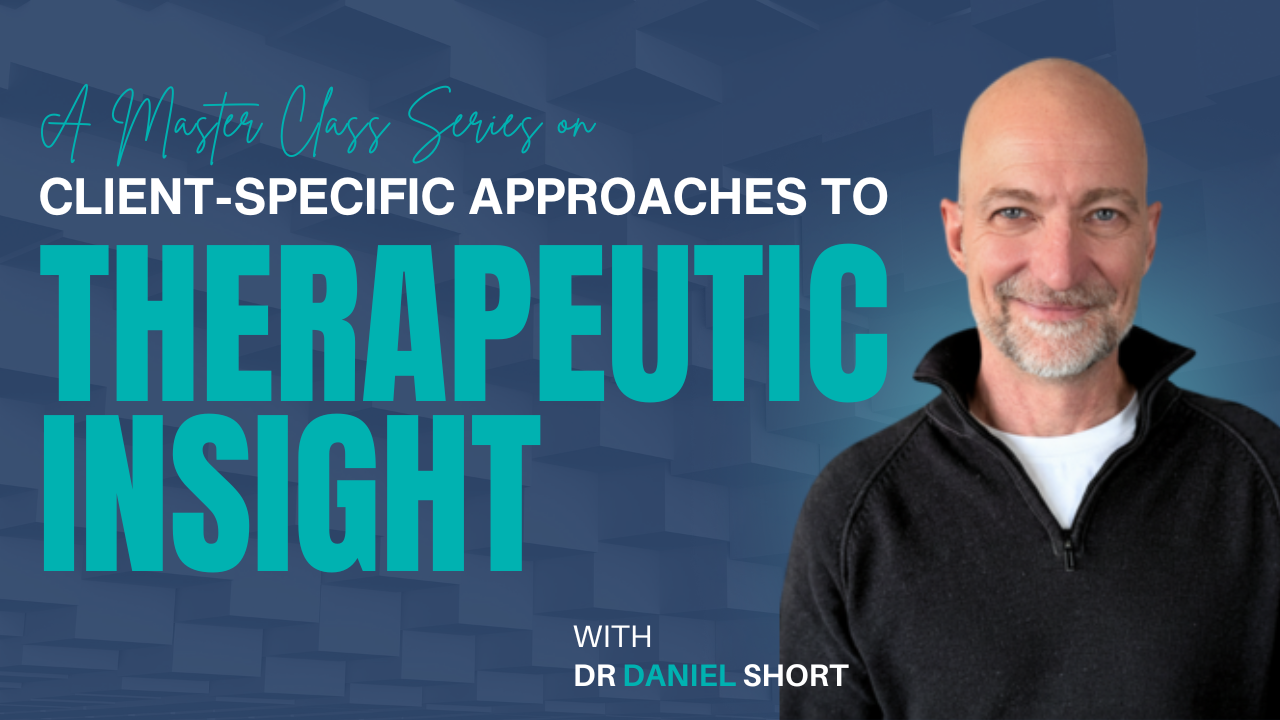
A Master Class Series on Client-Specific Approaches to Therapeutic Insight

Insight is not what you say to the client. It is what the client says to you. Dan Short opens with that distinction and keeps returning to it, because it rules out the thing most of us do when we can see the pattern before the client can, which is to explain it to them and watch it not land.
His problem with the literature is that insight gets filed by school of therapy rather than by function. You can read a great deal about insight in psychodynamic work, insight in Gestalt, insight in CBT, and come away no clearer on what you are actually aiming at with the person in front of you on Tuesday. So he built four categories from his own practice. Origin insight, the backstory that explains why this matters so much to this person. Disentanglement insight, which is transference taken wider than Freud framed it, and which separates a wife from a mother or a second marriage from a first. Identification insight, the hardest of the four, where a client recognises they are part of the problem, and which takes enough safety in the room to survive. And moral insight, the why rather than the how.
Six and a half hours across four sessions, one for each. He works from case material throughout, including a well-known Erickson case built around a single page of typescript, and cases of his own where insight work moved something that years of skills and strategies had not. He is a hypnotherapist by background and argues that the old split between suggestion and insight is a false one, so the methods are Ericksonian, but the categories are the point and they transfer to whatever you already practise.
You’ll walk away with
- Four working categories of insight, organised by what each one is for rather than by which school it came from, so you know which one you are aiming at in a given session
- Origin insight: building a coherent autobiographical account with a client, and why a life that holds together like a story changes what a person can do next
- Disentanglement insight, which is transference widened well past Freud’s framing, and a way of separating the person in front of the client from the person they are being confused with
- Identification insight: how a client comes to see their own part in the problem, and the conditions that have to be in place first, since the instinct is always to put distance between yourself and the problem
- Moral insight, the why rather than the how, and his argument for why the how tends not to hold without it
- The line between insight work and psychoeducation, which is a useful check on whether you are helping someone arrive somewhere or just telling them where you have arrived
- Shadow insight named as its own thing: what a client already knows outside awareness and is acting on without acknowledging, and what that tells you about timing
- A technique for getting back to a precipitating event by starting with whatever story the client offers and developing it, rather than interrogating for the memory you assume is there
- Worked cases where skills-based work had already failed, including a client who had studied every technique available and still could not drive alone
- A case-by-case sense of when to move from strategy and skills into insight work, from someone who does both and is candid about how he decides
Watch the course trailer
CPD Information For Mental Health Professionals
Enjoy complete flexibility with 100% self-paced learning you can access anytime, anywhere, and on any device. This course is included with your Tatra Training membership, along with every other course in the library.
Course Duration: 6.5 learning hours
Certificate and CPD hours: On completion you’ll receive a Certificate of Completion to support your CPD records. Your certificates are yours to keep.
Assessment: Complete a short quiz at the end (80% pass mark), which you can resit as many times as needed.
Revisit Anytime: Come back to the course as often as you like while your membership is active, whenever you want a refresher for practice.
CPD Eligibility: This program may be suitable for CPD for professionals such as:
- Psychologists
- Counsellors and Psychotherapists
- Social Workers
- Community Workers
- Mental Health Nurses
- General Practitioners (GPs)
- Occupational Therapists
CPD requirements vary between professional bodies, so please check with your association or credentialing body to confirm you can claim CPD hours/OPD points for this program and what evidence they require.
Course Content
Meet Your Instructor

Traditional therapy approaches that rely heavily on conscious insight can miss the profound healing potential that emerges when clinicians learn to work with clients' unconscious resources. Dan Short has spent over three decades mastering the art and science of Ericksonian hypnosis, becoming one of the world's leading authorities on unconscious process work and brief therapeutic interventions.
As Director of the Milton H. Erickson Institute of Phoenix and Executive Director of the Phoenix Institute of Ericksonian Therapy, Dr. Short represents the direct lineage of Milton Erickson's revolutionary approach to psychotherapy. His book Hope and Resiliency, co-authored with Betty Alice Erickson and Roxanna Erickson Klein, has been translated into seven languages and stands as a definitive guide to Ericksonian principles. His extensive research includes over 1,500 hours studying the original Erickson archives, giving him unparalleled insight into the master therapist's methods.
Dr. Short's expertise spans Ericksonian hypnosis, brief therapy, domestic violence treatment, trauma therapy, and couples/family therapy. His approach demonstrates how therapeutic relationships themselves become vehicles for transformation when practitioners learn to engage clients' unconscious wisdom. He specialises in showing clinicians how small shifts in language, timing, and therapeutic presence can create profound changes that bypass conscious resistance and accelerate healing.
What sets his training apart is depth combined with practical application. Short doesn't just teach hypnotic techniques - he shows practitioners how to cultivate the therapeutic artistry that makes Ericksonian approaches so effective. His international teaching at institutes in France, Italy, Spain, Mexico, and Japan gives him cross-cultural insights into how unconscious processes operate across diverse populations.
For your practice, expect to gain specific skills in therapeutic hypnosis, tools for accessing clients' unconscious resources, and frameworks for creating transformational therapeutic relationships. His methods particularly benefit clinicians who want to move beyond symptom-focused approaches to facilitate deeper, more lasting change.
Quick Win: Short's "therapeutic choice architecture" technique helps clinicians structure conversations so clients naturally discover their own solutions - often creating breakthrough insights that traditional directive approaches miss.
Qualifications
- Ph.D., Counseling Psychology, University of Massachusetts Amherst, 2000
- M.A., Counseling, University of North Texas, 1993
- APA-accredited internship, Houston, TX, 1996
- Licensed Clinical Psychologist
- Nearly 30 years of clinical experience
- Over 1,500 hours of research in Milton Erickson archives
Authored Books
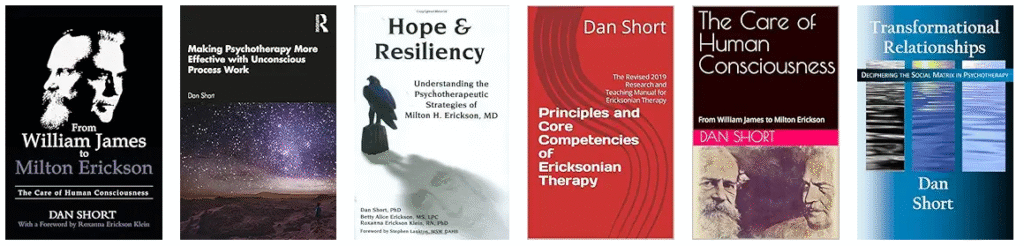
- Making Psychotherapy More Effective with Unconscious Process Work (2020)
- From William James to Milton Erickson: The Care of Human Consciousness (2020)
- Transformational Relationships (2010, Zeig, Tucker & Theisen)
- Hope and Resiliency (2005, co-author with Betty Alice Erickson & Roxanna Erickson Klein, Crown House Publishing, translated into Spanish, French, German, Italian, Japanese, Russian)
Teaching & Roles
- Director, Milton H. Erickson Institute of Phoenix
- Executive Director, Phoenix Institute of Ericksonian Therapy
- Adjunct Faculty, International Society of Hypnosis (ISH) Educational Board
- Clinical Instructor, Southwest College of Naturopathic Medicine
- Visiting Faculty, Various Ericksonian Institutes Worldwide
- Former Associate Director, Milton H. Erickson Foundation
- Former Executive Editor, Milton H. Erickson Foundation Newsletter (5 years)
Professional Practice
- Private Practice Psychologist, Scottsdale, AZ, 2003–present
- Clinical Supervisor, Graduate interns, various programs, ongoing
- Former Graduate Faculty Member, Argosy University
- Consultation groups for professionals, Phoenix metropolitan area
Featured Publications
- Multiple professional articles, book chapters, treatment manuals
- Blog author, Behavior.net
- Collaborative author, SAGE Encyclopedia of Counselling and Theory
- Academic researcher with extensive publications in professional journals
Speaking & Training
- International conference faculty worldwide
- Milton H. Erickson Foundation conference presenter
- Visiting faculty: France, Italy, Spain, Mexico, Japan
- YouTube presentations on Ericksonian therapy
- Global educational workshops and seminars
Ready to unlock your clients' unconscious healing resources? Discover how Dr. Short's Ericksonian methods can transform your therapeutic presence and help clients access profound change through their own innate wisdom.
Feedback & Reviews
This course includes:
- Lessons 5
- Topics 0
- Duration 6.5 hours
- Quizzes 1
- Language English