

Adult ADHD: Relationships & Sex, How to Treat Both Partners to Help Re-Balance the Relationship

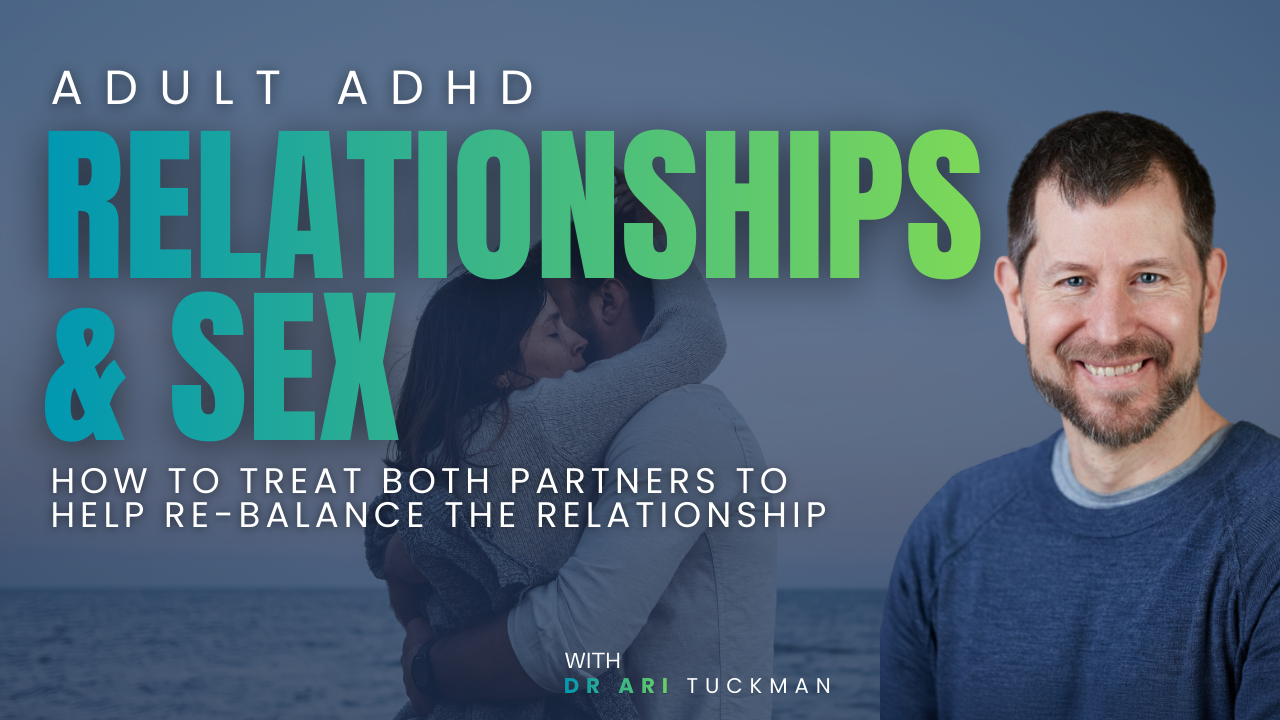
He wins the big case, then forgets the milk on the way home. She has spent years reading that as a statement about how much she matters. He has spent years hearing that nothing he does is ever good enough. Neither of them is having a good time, and neither of them is wrong about their own experience.
Ari Tuckman’s position is that this is not the grand betrayal, it is death by a thousand cuts, and that the ADHD is only half of it. The other half is what the couple built on top of it. One partner ends up thinking further ahead, so almost everything lands on their list, and they become the organised one, the one who checks, the one who is angry. The other stops trying, because it is always too late and always the wrong thing. He calls it the under-functioner and over-functioner dynamic, and he is direct that both people have a part in it. He says that partly so the partner with ADHD is not carrying the whole thing, and partly so the other partner sees they have some agency instead of waiting for the therapist to fix their spouse.
Six hours across two sessions, aimed at two groups: clinicians who treat adults with ADHD individually and have never done couples work, and couples and sex therapists who know ADHD is a thing but not much more. He covers what to expect from medication so you can hold that conversation without prescribing, the individual work that supports the couples work, the negotiation skills these couples need, and then a full section on their sex life, drawn from his own survey research and his book on the subject.
You’ll walk away with
- The under-functioner and over-functioner pattern named clearly, and a way to work with it that does not leave one partner as the identified problem
- Signals in your existing caseload that point at undiagnosed ADHD, including what the partner’s face does when you ask about follow-through, and the family history question that should always make you pause
- Enough grounding in stimulant medication to have a useful conversation with a client without prescribing, including what the common objections usually mean underneath
- Trust rebuilt from the mechanics rather than the feelings: consistency between words and actions, and Russ Ramsey’s idea of self-mistrust, where the problem is that the client cannot rely on themselves
- The difference between a preference and a limit, and a way to help a couple sort which of their arguments is which
- Clean requests instead of building a case, and why arguing the merits of a position tends to go nowhere in a relationship
- Why agreements fail even when both people meant them, and how to rework an agreement so it fits what actually happens on a Sunday
- The conflict-avoidant partner and the hostile partner as two sides of one problem, and what to do differently with each in the room
- Lie-inviting behaviour: how a partner’s reaction to bad news shapes how much honesty they get, and how to name that without excusing the lying
- A full section on the couple’s sex life, including how satisfaction, frequency and relationship quality track together, and using that as leverage with a partner who is not otherwise motivated to do the work
Watch the course trailer
CPD Information For Mental Health Professionals
Enjoy complete flexibility with 100% self-paced learning you can access anytime, anywhere, and on any device. This course is included with your Tatra Training membership, along with every other course in the library.
Course Duration: 6 learning hours
Certificate and CPD hours: On completion you’ll receive a Certificate of Completion to support your CPD records. Your certificates are yours to keep.
Assessment: Complete a short quiz at the end (80% pass mark), which you can resit as many times as needed.
Revisit Anytime: Come back to the course as often as you like while your membership is active, whenever you want a refresher for practice.
CPD Eligibility: This program may be suitable for CPD for professionals such as:
- Psychologists
- Counsellors and Psychotherapists
- Social Workers
- Community Workers
- Mental Health Nurses
- General Practitioners (GPs)
- Occupational Therapists
CPD requirements vary between professional bodies, so please check with your association or credentialing body to confirm you can claim CPD hours/OPD points for this program and what evidence they require.
Course Content
Meet Your Instructor

When your adult clients with ADHD struggle to follow through on treatment plans, or when ADHD strains a couple's intimacy and communication, you need strategies that work in real-world practice. Ari Tuckman, PsyD, MBA has spent more than 25 years translating ADHD science into practical tools that help clinicians support adults, couples, and families navigating attention challenges, executive function gaps, and relationship friction.
A frequent presenter, Dr. Tuckman's teaching emphasises psychoeducation and skill-building that clinicians can apply immediately. He has delivered more than 850 presentations and podcast interviews for professionals and the public across the United States and internationally in Sweden, Turkey, Greece, Mexico, England, Spain, Denmark, Canada, and Iceland.
Dr. Tuckman is the author of five books on ADHD, including ADHD After Dark (2019) and The ADHD Productivity Manual (2025), and was inducted into the CHADD Hall of Fame in 2023 for his significant contributions to the field. He has served as conference committee co-chair for CHADD's annual International Conference on ADHD, the largest ADHD conference in the US. His work has reached audiences on CNN and National Public Radio and has been cited in The New York Times, USA Today, The Washington Post, and The Boston Globe. He contributes regularly to ADDitude Magazine and Attention Magazine, keeping the ADHD clinical community informed on emerging research and practical innovations.
In his West Chester, Pennsylvania, private practice, Dr. Tuckman works with teens and adults living with ADHD, as well as couples and families affected by attention and executive function challenges. His clinical focus spans ADHD diagnosis and treatment, executive function coaching, couples therapy, and sex therapy — including how ADHD shapes intimacy, desire, and relationship dynamics. His approach is grounded in helping clients understand their brains first, then build systems that match how ADHD brains actually work, rather than fighting against them.
Whether you're refining your assessment protocols, coaching clients on productivity, or helping couples navigate ADHD-related conflict, Dr. Tuckman's frameworks offer clear, evidence-informed steps you can teach and adapt.
For clinicians, his courses and materials provide concrete intervention strategies, language for psychoeducation, and tools to address the executive function deficits that undermine treatment gains. You'll learn how to support clients in managing time, organising tasks, sustaining attention, and regulating emotions — and how to help couples repair trust and intimacy when one or both partners have ADHD.
Qualifications
- Doctor of Psychology (PsyD)
- Master of Business Administration (MBA)
- Licensed psychologist in private practice
Selected Books
- The ADHD Productivity Manual (2025)
- ADHD After Dark: Better Sex Life, Better Relationship (2019)
- Understand Your Brain, Get More Done: The ADHD Executive Functions Workbook (2012)
- More Attention, Less Deficit: Success Strategies for Adults with ADHD (2009)
- Integrative Treatment for Adult ADHD: A Practical, Easy-to-Use Guide for Clinicians (2007)
Teaching & Roles
- Conference committee co-chair, CHADD International Conference on ADHD
- Former board member, CHADD
- Former vice president, Attention Deficit Disorder Association (ADDA)
- Frequent international speaker (850+ presentations and podcast interviews across nine countries)
- Faculty, Coach Approach Training Institute
Feedback & Reviews
This course includes:
- Lessons 5
- Topics 0
- Duration 6 hours
- Quizzes 5
- Language English