

DBT Tools to Help Stubbornly Resistant and Reactive Clients

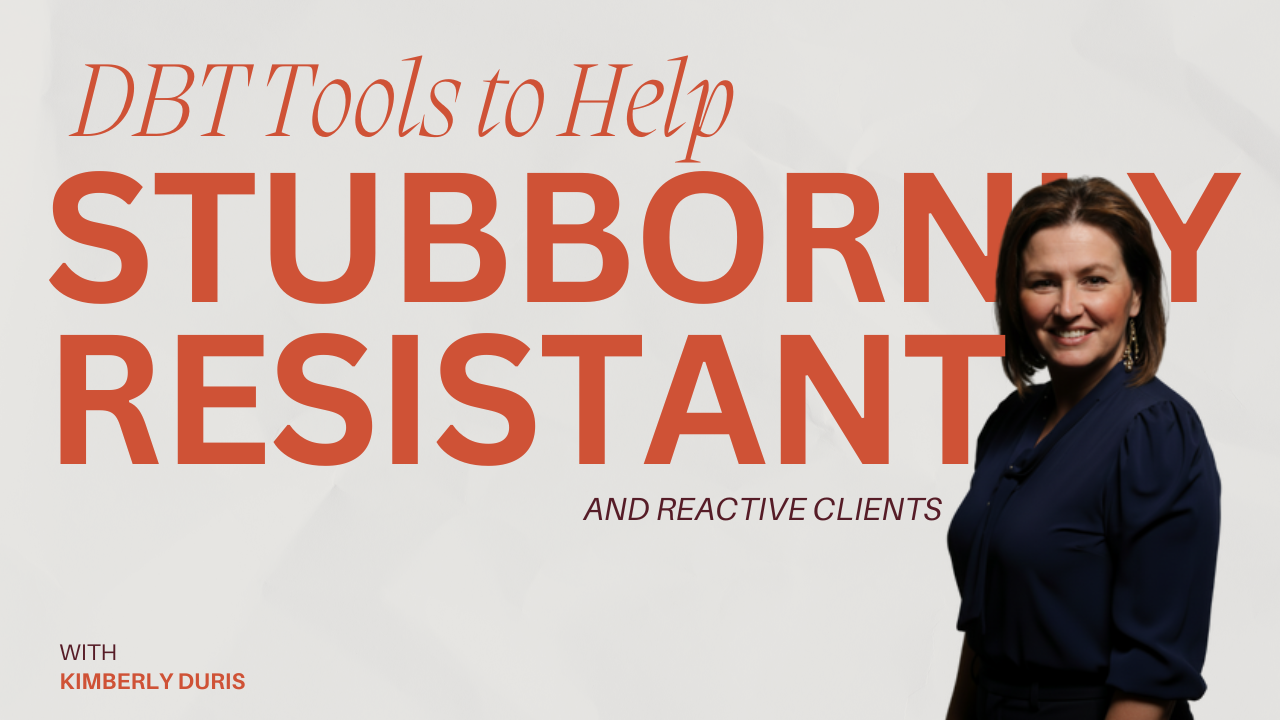
Your client has decided they cannot change. They have always been this way, other people are not going to change either, and they have dug in. You can feel the session going in circles and you are starting to dread the appointment.
Kimberly Duris’s reframe is the useful part. In DBT that is not a personality you have to work around, it is a therapy-interfering behaviour, which makes it something you can name and target rather than tolerate. And you do not need a borderline personality disorder diagnosis for the model to apply. She trained in DBT twenty years ago at an agency using it in full, with skills groups, individual work and a therapist consultation team, and most of her clinical career since has been outside the population people assume DBT is for.
Three hours. She grounds the model first, including the dialectic the whole approach turns on: your client is doing the best they can with the skills they have, and they need to do better, and both are true at once. Then the targets of dysregulation across emotion, behaviour, relationships, sense of self and thinking. Then the practical work, including what to do with the client who is dug in, how the therapy relationship itself becomes the place to practise, and where she thinks the model runs out.
You’ll walk away with
- Resistance reframed as a therapy-interfering behaviour, which turns something you have been enduring into something you can name and work on
- The central dialectic held properly: your client is doing the best they can and needs to do better, without either half cancelling the other
- Behaviour understood as making sense in the context it developed in, which is a different move from identifying thoughts as distorted and restructuring them
- Willingness and wilfulness as a working distinction, and what to do at the point a client digs in rather than after they have
- Five targets of dysregulation across emotion, behaviour, relationships, self-image and thinking, so you can locate where the trouble actually sits
- Neuroplasticity used deliberately with the client who believes they are fixed, including a short piece of material you can build psychoeducation around
- The therapy relationship worked as a live sample of the client’s relationships outside it, including therapist self-disclosure about how you are experiencing them
- Validation of a client’s internal experience while still holding them responsible for the work, which is the balance most attempts at this get wrong in one direction or the other
- Where the model applies beyond its usual population, including addiction work where the physiological hold makes the digging in harder
- An honest account of the limitations, including where DBT is not the right fit for a resistant client
Watch the course trailer
CPD Information For Mental Health Professionals
Enjoy complete flexibility with 100% self-paced learning you can access anytime, anywhere, and on any device. This course is included with your Tatra Training membership, along with every other course in the library.
Course Duration: 3 learning hours
Certificate and CPD hours: On completion you’ll receive a Certificate of Completion to support your CPD records. Your certificates are yours to keep.
Assessment: Complete a short quiz at the end (80% pass mark), which you can resit as many times as needed.
Revisit Anytime: Come back to the course as often as you like while your membership is active, whenever you want a refresher for practice.
CPD Eligibility: This program may be suitable for CPD for professionals such as:
- Psychologists
- Counsellors and Psychotherapists
- Social Workers
- Community Workers
- Mental Health Nurses
- General Practitioners (GPs)
- Occupational Therapists
CPD requirements vary between professional bodies, so please check with your association or credentialing body to confirm you can claim CPD hours/OPD points for this program and what evidence they require.
Course Content
Meet Your Instructor

Adolescents struggling with substance abuse and personality disorders - and the families trying to support them - often fall through the cracks of traditional mental health systems that aren't designed to address the complex interplay of developmental, psychological, and social factors affecting young people. Kimberly Duris has dedicated over 25 years to understanding and treating these challenging presentations, becoming a recognised expert who bridges clinical practice, academic training, and community leadership to create comprehensive support systems for vulnerable youth.
As Full Professor in the Clinical Mental Health Counseling Program at Lewis University and Clinical Director of Guiding Light Counseling, Dr. Duris brings unique expertise that spans clinical practice, educator training, and community service. Her EdD in Counselor Education and Supervision, combined with her roles as Licensed Clinical Professional Counselor and Certified Alcohol and Drug Abuse Counselor, demonstrate her commitment to both direct service and professional development. Her co-authored book What You Need to Know about Personality Disorders (Bloomsbury Academic) and recognition as a media expert in the Newswise Expert Database reflect her ability to translate complex clinical knowledge into accessible guidance for professionals and families.
Dr. Duris's expertise spans children and adolescent mental health, substance abuse counseling, personality disorders, community mental health, clinical supervision, and counselor education. Her approach recognises that effective treatment of adolescents requires understanding developmental psychology, family systems, school environments, and community resources. She specialises in cases where substance abuse and personality disorders co-occur, situations requiring intensive community support, and training the next generation of counselors to work effectively with high-risk youth.
What sets her training apart is comprehensive systems thinking combined with real-world experience. Duris doesn't just teach individual therapy techniques - she shows practitioners how to coordinate care across multiple systems while advocating for policy changes that support vulnerable youth. Her role as elected school board president demonstrates her commitment to creating environments where all children can thrive academically, socially, and emotionally.
For your practice, expect to gain specific interventions for adolescent substance abuse, tools for working with emerging personality disorders, and frameworks for coordinating care across family, school, and community systems. Her approach particularly benefits clinicians working with high-risk adolescents, those treating dual-diagnosis presentations, or practitioners wanting to develop advocacy and systems-change skills.
Quick Win: Duris's "developmental assets mapping" technique helps practitioners quickly identify the protective factors and risk factors in an adolescent's environment - helping to reveal intervention opportunities that traditional individual therapy approaches can sometimes miss.
Qualifications
- EdD, Counselor Education and Supervision, Lewis University, 2015
- MA, Counseling Psychology, Lewis University, 2000–2002
- BA, Psychology and Criminal Social Justice, Lewis University, 1996–2000
- Licensed Clinical Professional Counselor (LCPC), Illinois
- Certified Alcohol and other Drug Abuse Counselor (CADC)
- Certified Clinical Supervisor (CCS)
- 25+ years experience in mental health counseling
Authored Publications
- What You Need to Know about Personality Disorders (co-author)
- Multiple scholarly articles on counseling psychology, personality disorders, substance abuse treatment, and counselor education
- Professional publications in peer-reviewed journals on mental health topics
Leadership & Teaching
- Full Professor, Clinical Mental Health Counseling Program, Department of Psychology, Lewis University, January 2007–present (18+ years)
- President, Board of Education, Roselle School District 12, May 2019–present (elected 2019, re-elected 2025, term expires April 2029)
- Clinical Director, Guiding Light Counseling, Bolingbrook, IL, July 2009–present (16+ years)
Professional Experience
- Mental Health Counselor/Director, Psychosocial Rehabilitation Program, Trinity Services Inc., December 2002–January 2007 (4 years)
- Program Manager/PsychTech, Maryville Academy, July 2000–October 2003 (3+ years)
- Various clinical positions in community mental health, 2000–present
Speaking & Training
- Professional conference presentations on personality disorders, substance abuse, and adolescent mental health
- Educational workshops for mental health professionals
- Community presentations on child development and mental health
- University guest lectures and academic presentations
- Professional training in clinical supervision and counselor education
Ready to develop comprehensive approaches to adolescent mental health that address individual, family, and community factors? Discover how Dr. Duris's systems-based methods can help you create effective interventions for high-risk youth while building the community partnerships essential for lasting change.
Feedback & Reviews
This course includes:
- Lessons 3
- Topics 0
- Duration 3 hours
- Quizzes 1
- Language English