

Helping Clinicians Heal from Client Suicide

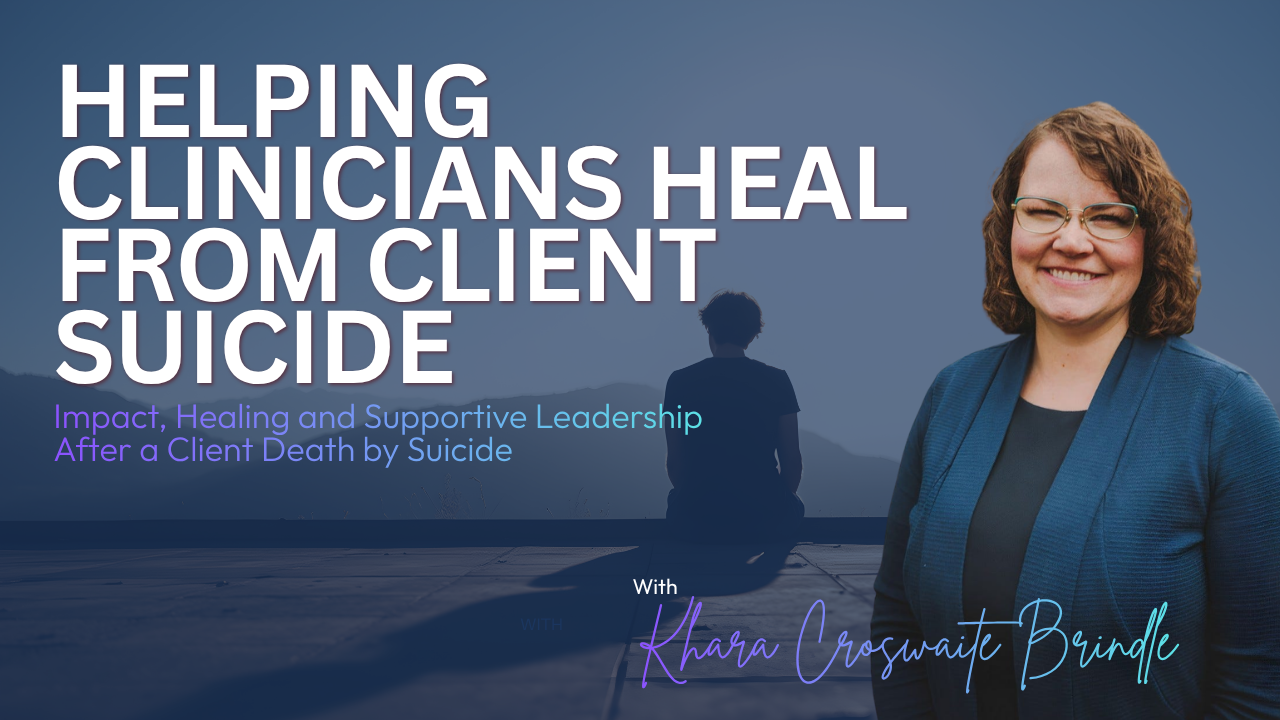
The news often arrives between sessions. A voicemail, sometimes a text, letting you know your client has died by suicide. Within minutes, many clinicians already feel responsible, whether they saw the client last week or months ago. Then they walk into their next session and say nothing.
Dr Lena Salpietro calls this confidential grief: a loss you feel you can’t talk about, partly because the client’s information stays private and partly because of the fear of blame, judgement or losing your licence. So clinicians keep seeing clients, stop sleeping, question whether they’re any good at this work, and quietly wonder about leaving the field. Leaders often mean well, then reach for “What happened?” or the case file before anyone has asked how the clinician is.
Khara Croswaite Brindle is a clinician survivor herself and has trained clinicians in suicide assessment since 2017. In this course she follows Jay, a clinician who has just heard that her client has died, from the first 30 minutes to the first anniversary. At each stage you see what helps from a colleague and what helps from a supervisor or manager.
Along the way Khara shares findings from her survey of more than 200 clinicians on career traumas, the PERMS framework for recognising impact across five domains of self, her LEAN framework for healing, grief tools that protect confidentiality, a meaning-making exercise drawn from David Kessler’s work, and eight tips for leaders who want to keep good clinicians in the field.
It’s written for clinicians who have lost a client, or worry that one day they will, and for anyone who supervises, manages or works alongside them. If it happens to you, or to the person in the office next door, you’ll know what to say in the first half hour and what to ask before the anniversary.
Before you start: this course talks openly about client suicide and includes reflective exercises that can bring up strong feelings. Khara practises in Colorado, so some data, resources and examples are from the United States.
You’ll walk away with
- An internal check exercise to notice your own beliefs and body responses to suicidal language before you support anyone else
- What to say, and what to hold back, in the first 30 minutes after a colleague hears their client has died
- Language for confidential grief and the career traumas, or adverse psychological events, that drive burnout and career exit
- The PERMS framework for recognising impact across physical, emotional, relational, mental and spiritual domains
- A stage-by-stage picture of support at one week, one month, three months, six months and the first anniversary
- The LEAN framework: Listen to your needs, Embrace grief and loss work, Ask for help, Name meaning
- Grief tools that protect client confidentiality, from an unsent client letter to marking a meaningful date
- Two writing exercises for self-compassion and meaning making: the Dear Colleague letter and the three stories exercise
- Helpful and hurtful responses to client suicide, including why “died by suicide” matters
- Eight tips for supervisors and managers, plus the self-disclosure “short stack” for deciding when to share your own experience
Watch a preview of the course
CPD Information For Mental Health Professionals
Enjoy complete flexibility with 100% self-paced learning you can access anytime, anywhere, and on any device. This course is included with your Tatra Training membership, along with every other course in the library.
Course Duration: 3 learning hours
Certificate and CPD hours: On completion you’ll receive a Certificate of Completion to support your CPD records. Your certificates are yours to keep.
Assessment: Complete a short quiz at the end (80% pass mark), which you can resit as many times as needed.
Revisit Anytime: Come back to the course as often as you like while your membership is active, whenever you want a refresher for practice.
CPD Eligibility: This program may be suitable for CPD for professionals such as:
- Psychologists
- Counsellors and Psychotherapists
- Social Workers
- Community Workers
- Mental Health Nurses
- General Practitioners (GPs)
- Occupational Therapists
CPD requirements vary between professional bodies, so please check with your association or credentialing body to confirm you can claim CPD hours/OPD points for this program and what evidence they require.
Course Content
Meet Your Instructor

Losing a client to suicide, facing a complaint, or carrying a heavy supervision load can quietly wear a clinician down, and most of us were never trained for it. Khara Croswaite Brindle has spent her career supporting clinicians through these moments, as a supervisor, trainer and author.
Khara is a Licensed Professional Counselor and Approved Clinical Supervisor based in Colorado, USA. She owns Croswaite Counseling, PLLC, co-founded Supervisionary, and teaches as adjunct faculty at the University of Denver. She has supervised clinicians since 2014 and trained them in suicide assessment and safety planning since 2017. Her books include The Empowerment Model of Clinical Supervision, co-authored with Christina Murphy, and Moving from ALERT to Acceptance: Helping Clinicians Heal from Client Suicide. She has presented for the American Association of Suicidology and the International Association for Suicide Prevention, and gave the TEDx talk "The Burden of Busyness".
Her focus areas are clinical supervision and leadership, suicide assessment and safety planning, clinician grief after client suicide, burnout and perfectionism, and financial therapy for therapists. Having experienced a client suicide herself, she writes about what she calls confidential grief: the loss clinicians often carry quietly because of their professional role.
What sets her training apart is that she speaks to the clinician as well as the client. Khara pairs practical frameworks with honest discussion of what this work costs, so practitioners leave with both structure and permission to look after themselves.
For your practice, expect to gain a structured approach to suicide risk assessment and safety planning, supervision practices that build capability rather than dependence, and ways to recognise and respond to your own grief or burnout. Her work particularly suits supervisors, practice owners and clinicians working with high-risk clients.
Quick Win: The Empowerment Model asks supervisors to move between the roles of leader, teacher, consultant, researcher and colleague, while deliberately stepping out of the counsellor role. Before your next supervision session, decide which role your supervisee most needs from you that day.
Qualifications
- MA
- Licensed Professional Counselor (LPC), Colorado
- Approved Clinical Supervisor (ACS)
- Certified Financial Therapist (CFT-I)
Authored Books
- Moving from ALERT to Acceptance: Helping Clinicians Heal from Client Suicide (2024, Rowman & Littlefield)
- Helping Clinicians Heal from Client Suicide: A Workbook (2024)
- Understanding Ruptured Mother-Daughter Relationships (2023, Rowman & Littlefield)
- The Empowerment Model of Clinical Supervision (2019, 2nd ed. 2023, co-authored with Christina Murphy)
- Your Enneagram and Money (co-authored with Hannah DeGroot)
- Perfectioneur: From Workaholic to Well-Balanced (2020)
Media & Recognition
- TEDx talk, "The Burden of Busyness" (TEDxCherryCreekWomen, 2021)
- Featured by CNBC, Fortune Well, BBC Mundo and MarketWatch
- Journal of Financial Therapy article on the Empowerment Model (2023)
Teaching & Roles
- Owner, Croswaite Counseling, PLLC
- Co-founder, Supervisionary
- Director of Training, Financial Therapy Clinical Institute
- Adjunct Faculty, University of Denver
- Founder, Catalively (youth suicide prevention)
Training & Speaking
- American Association of Suicidology
- International Association for Suicide Prevention (New Zealand)
- Canadian Counselling and Psychotherapy Association
- Financial Therapy Association
Looking for a steadier way to handle high-risk work and support the clinicians around you? Explore Khara's courses below.
Feedback & Reviews
This course includes:
- Lessons 4
- Topics 14
- Duration 3 hours
- Quizzes 1
- Language English