

Navigating Narcissism with Courage and Empathy – Clinical Tools and Techniques

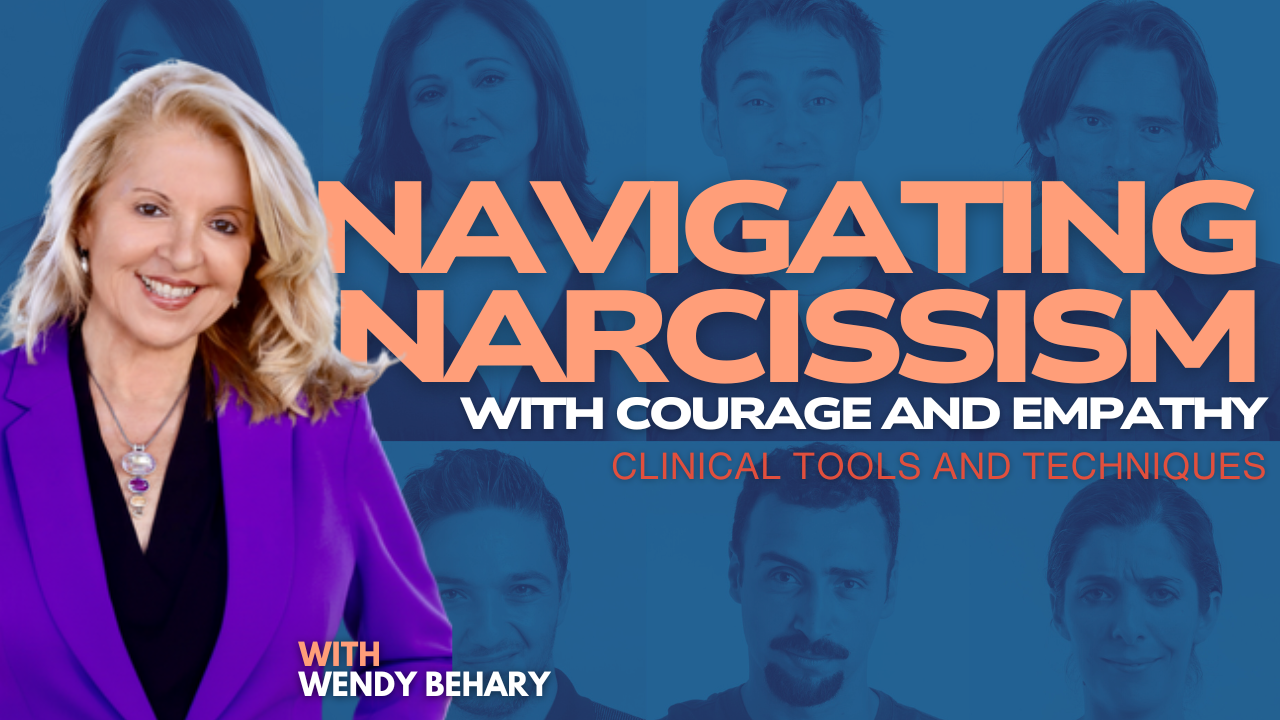
Narcissists are notoriously difficult clients. While often intelligent, charming, and self-confident, they also tend to be highly self-absorbed, arrogant, demanding, condescending, incapable of empathy, and possessed with a sense of entitlement. As therapists, the complexities of the narcissist can arouse our curiosity but treating them can arouse our sense of inadequacy.
While their exploitative and arrogant demeanor can leave you weary, irritated, intimidated and even defeated – all you really want is to feel competent, confident, and effective with making a difference in their lives; and even more so, in the lives of the narcissist’s family.
Watch best-selling author and narcissist expert, Wendy T. Behary, MSW, LCSW, as she guides you through highly effective techniques that will transform your clinical practice.
Wendy’s innovative techniques will help you navigate and breakthrough narcissistic self-defeating patterns and achieve enduring change. Learn how to skilfully:
- Set healthy limits, bypass obstacles, hold the client accountable
- Confront avoidance, approval-seeking, entitlement, and aggression
- Connect with the vulnerable part of the narcissist
- Conquer the most challenging moments in sessions
That’s right, no more feeling frustrated with the lack of treatment progress. No more feeling intimidated and defeated. No more feelings of dread in the pit of your stomach when their name is on your schedule!
Enrol today, to learn how to transform your treatment approach to these challenging clients!
This course aims to equip you with the knowledge, tools, and strategies to deal with this challenging population and promote meaningful and sustainable change.
As therapists, we need to identify and stabilize our personal challenges, such as our own schemas, which can be a significant obstacle to treatment effectiveness. This course will help you develop a sturdy self in the chair to deal with the challenges of working with narcissistic clients effectively.
We will also teach you how to create customized dialogues that maintain leverage and enhance opportunities to access client vulnerability and emotion. Finally, we will show you how to facilitate treatment with offended partners, which involves the recovery and fortifying of a voice of advocacy, setting limits, cultivating leverage for accountability, identifying the impact of unacceptable behaviors, and enforcing reasonable consequences that act as motivational drivers for the narcissist to seek treatment.
This training will provide participants clinical knowledge and tools to:
a). Describe the Schema Therapy model and how to comprehensively conceptualize Narcissism and NPD in formulating treatment strategies.
b). Acquire the use of a highly effective strategy known as empathic confrontation to gain and maintain leverage and avoid power struggles, address entitlement and lack of reciprocity, access reasonable responsibility, and set limits with the narcissist.
c). Learn and observe how to apply specific strategies such as replacing self-defeating patterns and coping modes with healthy and adaptive modes via the moment-to-moment encounters in the therapy relationship.
d). Develop a sturdy self in the chair by identifying and stabilizing the therapist’s personal challenges—our own schemas—a major obstacle to treatment effectiveness.
e). Create customized dialogues that maintain leverage and enhance opportunities to access client vulnerability and emotion.
f). Learn how to facilitate treatment with offended partners; the recovery and fortifying of a voice of advocacy; setting limits, cultivating leverage for accountability; identifying the impact of unacceptable behaviors, and enforcing reasonable consequences that act as motivational drivers for the narcissist to seek treatment.
CPD Information For Mental Health Professionals
Enjoy complete flexibility with 100% self-paced learning you can access anytime, anywhere, and on any device. Pay once for lifetime access.
Course Duration: 6 learning hours
Certificate and CPD hours: On completion you’ll receive a Certificate of Completion to support your CPD records.
Assessment: Complete a short quiz at the end (80% pass mark), which you can resit as many times as needed.
Lifetime Access: Your access to the course does not expire, so you can revisit key concepts anytime you want a refresher for practice.
CPD Eligibility: This program may be suitable for CPD for professionals such as:
- Psychologists
- Counsellors and Psychotherapists
- Social Workers
- Community Workers
- Mental Health Nurses
- General Practitioners (GPs)
- Occupational Therapists
CPD requirements vary between professional bodies, so please check with your association or credentialing body to confirm you can claim CPD hours/OPD points for this program and what evidence they require.

Course Content
Meet Your Instructor

Individuals trapped in relationships with narcissistic partners who use manipulation, gaslighting, and emotional abuse to maintain control - and the practitioners trying to help both narcissists and their victims break these destructive patterns - can need more than traditional therapy approaches to navigate these complex dynamics safely and effectively. Wendy Behary has spent over 30 years pioneering Schema Therapy approaches to narcissistic personality disorder, becoming the world's leading expert in treating narcissists while helping their partners "disarm" manipulative behaviors and reclaim their lives.
As Founder and Clinical Director of The Cognitive Therapy Center of New Jersey and Director of The Schema Therapy Institutes of NJ-NYC-DC, Behary brings unparalleled expertise developed through direct training with Schema Therapy founder Dr. Jeffrey Young since 1989. Her international bestseller Disarming the Narcissist: Surviving and Thriving with the Self-Absorbed (translated into 15+ languages, now in its 3rd edition) has become the definitive guide for understanding and responding to narcissistic behavior. Her role as former President of the International Society of Schema Therapy (2010-2014) and Founding Fellow of The Academy of Cognitive Therapy under Aaron T. Beck demonstrates her exceptional standing in both cognitive and schema therapy communities.
Behary's expertise spans narcissistic personality disorder treatment, high-conflict couples therapy, schema therapy, betrayal trauma, and what she calls helping people develop "empathic confrontation" skills to deal with narcissistic individuals without becoming victims or enablers. Her approach recognises that narcissistic behavior stems from deeply rooted emotional schemas that require specialised interventions, while also acknowledging that partners and family members need specific skills to protect themselves and potentially influence positive change. She specialises in treating both narcissists who are genuinely motivated to change and their partners who need to learn how to respond effectively to manipulative behaviors.
What sets her training apart is dual perspective expertise combined with schema therapy depth. Behary doesn't just teach about narcissistic abuse - she shows practitioners how to work therapeutically with actual narcissists while simultaneously helping their victims develop the skills needed to either improve the relationship or safely disengage. Her integration of schema therapy with practical relationship skills creates comprehensive approaches that address both underlying personality patterns and immediate safety concerns.
For your practice, expect to gain specific techniques for treating narcissistic personality presentations, tools for helping victims of narcissistic abuse, and frameworks for conducting high-conflict couples therapy safely. Her approach particularly benefits practitioners working with personality disorders, those treating relationship trauma, or clinicians wanting to develop expertise in working with both perpetrators and victims of psychological abuse.
Quick Win: Behary's "empathic confrontation" technique helps partners of narcissists respond to manipulation without escalating conflict - in many cases creating the first sense of personal power they've experienced while potentially opening space for genuine dialogue about behavioural change.
Qualifications
- MSW, Social Work, Rutgers University
- BA, Psychology, Rutgers University
- Licensed Clinical Social Worker (LCSW), New Jersey
- 35+ years post-graduate training in Schema Therapy with Dr. Jeffrey Young (1989–present)
- 30+ years advanced level certifications in Schema Therapy and Cognitive Therapy
Authored Publications
- Disarming the Narcissist: Surviving and Thriving with the Self-Absorbed (1st Edition 2008, 2nd Edition 2013, 3rd Edition 2021, New Harbinger Publications, translated into 15+ languages, international bestseller)
- Multiple professional chapters (co-author) on Schema Therapy and Cognitive Therapy (Wiley Publications and APA Press)
- Articles on Schema Therapy (co-author) in professional journals
- Contributing chapter author on Schema Therapy for narcissism
Professional Experience
- Founder and Clinical Director, The Cognitive Therapy Center of New Jersey, Springfield, NJ, 1991–present (33+ years)
- Founder and Director, The Schema Therapy Institutes of NJ-NYC-DC, 1992–present (32+ years)
- Former President, International Society of Schema Therapy (ISST), 2010–2014
- Chair, Schema Therapy Development Programs Sub-Committee, ISST, current
- Founding Fellow and Consulting Supervisor, The Academy of Cognitive Therapy (Aaron T. Beck's Institute)
- Faculty, Cognitive Therapy Center and Schema Therapy Institute of New York, 1989–2012 (23 years)
- Training and Certification Coordinator, ISST Executive Board, 2008–2010
Media & Speaking
- International recognition as leading narcissism expert
- Featured expert, Psychotherapy Networker Magazine
- Media appearances on national and international television, radio, podcasts
- Regular contributor to professional psychology publications
- International lecturer on Schema Therapy and narcissism
- Corporate speaking engagements on interpersonal conflict resolution
- Co-host, "Co-Parenting with a Narcissist" online community with Susan Stiffelman
Clinical Specialties
- Narcissistic personality disorder treatment using Schema Therapy
- High-conflict couples therapy and relationship therapy
- Partners and families dealing with narcissistic individuals
- Betrayal trauma and PTSD from narcissistic abuse
- Schema Therapy and Cognitive Behavioral Therapy (CBT)
- Empathic confrontation techniques
- Interpersonal skills coaching and public speaking coaching
Treatment Philosophy
- Helping people develop skills to either improve relationships with narcissistic individuals through empathic confrontation or safely disengage while addressing the underlying schema patterns that drive narcissistic behavior in those genuinely motivated to change.
Ready to develop expertise in the complex dynamics of narcissistic relationships while learning to work safely with both narcissists and their victims? Discover how Wendy Behary's Schema Therapy methods can help you navigate these challenging cases while empowering clients to either transform toxic relationships or find the strength to leave them.
Feedback & Reviews
This course includes:
- Lessons 4
- Topics 0
- Duration 6 hours
- Quizzes 1
- Language English