

Suicide and Parasuicide in Borderline Personality Disorder: Evidence-Based Strategies for Diagnosis and Treatment

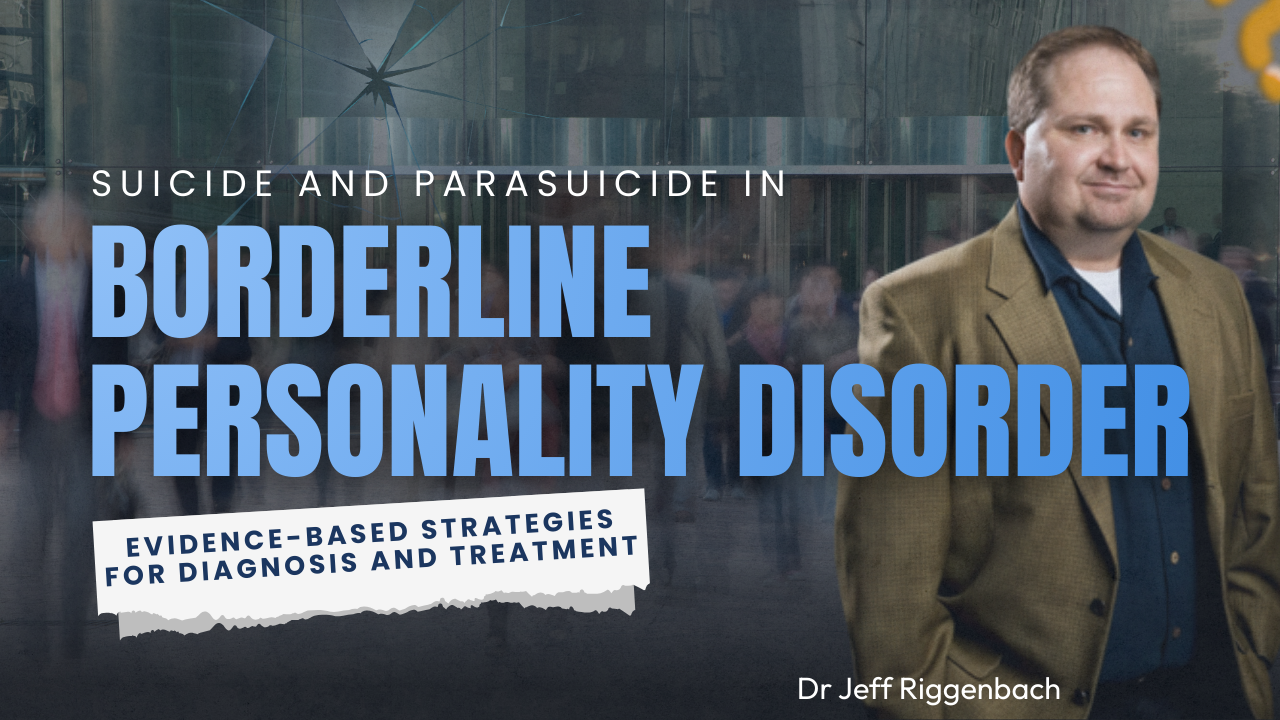
Suicide and parasuicide (non-suicidal self-injury) are prominent features in borderline personality disorder. Although both are briefly described in the same diagnostic criteria, they are distinctly different clinical phenomena and require different treatment approaches. While evidence-based treatments for BPD have existed for over 20 years now, even the most skilled clinicians still lack a cohesive approach for conceptualising and treating this difficult population and oftentimes find themselves at a loss regarding how to deal with these sometimes confusing behaviours in this challenging population.
They can be chaotic, impulsive and unstable. Research also suggests an estimated 75% of individuals with this diagnosis will commit at least one self damaging act and 10% eventually die by suicide.
The good news is, there is hope for helping these individuals find a life worth living.
Leave this online training with internationally recognised personality disorder expert Jeff Riggenbach equipped with the clinical tools to:
- Distinguish suicide from parasuicide and learn specific interventions for each.
- Have conversations with your clients about the BPD diagnosis in a way that minimises defensiveness and elicits client buy-in.
- Demonstrate an understanding of the 3 ways schemas are maintained and the role that they play in driving destructive behaviours.
- Differentiate BPD from PTSD, Bipolar disorder, and other sometimes difficult to discern conditions.
- Recognise the 8 most common reasons for NSSI endorsed by clients with BPD and apply clinically appropriate interventions for each.
- Discuss clinically appropriate disposition options in response to dangerousness.
Learning Objectives:
This training will provide participants clinical knowledge and tools to:
a). Develop an in-depth understanding of the nine essential characteristics of Borderline Personality Disorder.
b). Acquire language skills for having the conversation with clients and family members in a way that decreases client defensiveness an elicits buy-in.
c). Learn the 8 motivations for NSSI highly endorsed by clients with BPD and appropriate intervention strategies for each.
d). Separate 3 clinically significant “Suicidal” components to BPD and learn how to assess for each.
e). Acquire key differential diagnosis skills for Borderline PD, PTSD, Bipolar Disorder and other clinically overlapping conditions.
f). Learn the 18 maladaptive schemas present in BPD and their role in driving destructive behaviors.
g). Develop skills in assessment of suicidality and parasuicidality and decision-making skills regarding appropriate levels of care for each.
h). Utilise reasons for living to enhance hope and decrease suicide attempts.
i). Learn critical keys for safety planning specific to the BPD population.
CPD Information For Mental Health Professionals
Enjoy complete flexibility with 100% self-paced learning you can access anytime, anywhere, and on any device. Pay once for lifetime access.
Course Duration: 2.5 learning hours
Certificate and CPD hours: On completion you’ll receive a Certificate of Completion to support your CPD records.
Assessment: Complete a short quiz at the end (80% pass mark), which you can resit as many times as needed.
Lifetime Access: Your access to the course does not expire, so you can revisit key concepts anytime you want a refresher for practice.
CPD Eligibility: This program may be suitable for CPD for professionals such as:
- Psychologists
- Counsellors and Psychotherapists
- Social Workers
- Community Workers
- Mental Health Nurses
- General Practitioners (GPs)
- Occupational Therapists
CPD requirements vary between professional bodies, so please check with your association or credentialing body to confirm you can claim CPD hours/OPD points for this program and what evidence they require.

Course Content
Meet Your Instructor

High-conflict personalities, treatment-resistant clients, and complex cases involving borderline personality disorder can leave clinicians feeling frustrated and ineffective - but these challenging presentations don't have to derail therapeutic progress. Jeff Riggenbach has spent over 20 years developing practical, evidence-based tools that help transform how practitioners work with their most difficult cases, earning him international recognition as "the practical tools guy" and becoming one of the world's most sought-after trainers in cognitive behavioral interventions.
As a three-time bestselling, award-winning author and Diplomat of the Academy of Cognitive Therapy, Dr. Riggenbach brings unparalleled expertise in translating complex therapeutic concepts into immediately usable clinical tools. His books The CBT Toolbox and The BPD Toolbox (Amazon #1 new release) have become essential resources for practitioners worldwide, while his latest work Disarming High Conflict Personalities addresses one of the most challenging aspects of clinical and organisational work. His training at the Beck Institute of Cognitive Therapy and Research, combined with 20 years directing CBT-based treatment programs in psychiatric hospitals where he served over 3,000 clients, gives him deep understanding of what actually works with resistant populations.
Dr. Riggenbach's expertise spans Cognitive Behavioral Therapy, Dialectical Behavior Therapy, Schema-Focused Cognitive Therapy, personality disorders treatment (especially Borderline Personality Disorder), trauma and addiction, and high-conflict personality management. His approach bridges the gap between academic research and frontline clinical reality, showing practitioners how to adapt evidence-based techniques for clients who don't fit textbook presentations. He specialises in cases where traditional therapy approaches have failed, particularly with clients who are hostile, manipulative, or treatment-resistant.
What sets his training apart is practical applicability under real-world conditions. Riggenbach doesn't just teach theory - he shows clinicians exactly what to say and do when facing their most challenging moments. His international training reach across all 50 U.S. states, Canada, Mexico, UK, Malta, Australia, New Zealand, and South Africa demonstrates his ability to adapt techniques across diverse populations and practice settings.
For your practice, expect to gain specific intervention scripts for difficult situations, tools for managing your own emotional responses to challenging clients, and frameworks for maintaining therapeutic progress with treatment-resistant cases. His approach particularly benefits clinicians working in high-stress environments, those dealing with personality disorders, or practitioners who feel burned out from difficult cases.
Quick Win: Riggenbach's "emotional regulation interrupt" technique helps clinicians quickly de-escalate volatile therapeutic situations while maintaining professional boundaries - helping to prevent session ruptures and keeping treatment on track.
Qualifications
- Ph.D., Christian Counseling
- Licensed Professional Counselor (LPC), Oklahoma, current
- Diplomat of the Academy of Cognitive Therapy
- Certified Cognitive Therapist, Beck Institute of Cognitive Therapy and Research, Philadelphia
- John Maxwell Team Certified Speaker/Trainer/Coach
- Certified Behavioral Consultant
- 20+ years clinical experience
Authored Books
- Disarming High Conflict Personalities: Dealing with the 8 Most Difficult People in Your Life Before You Burnout (latest release)
- The BPD Toolbox: A Practical Evidence-Based Guide to Regulating Intense Emotions (2016, Amazon #1 new release, award-winning)
- The CBT Toolbox: A Workbook for Clients, Clinicians and Coaches (2012, 1st and 2nd editions, bestseller)
- Seven total publications
Professional Experience
- International Speaker/Trainer/Coach, John Maxwell Team, current
- Clinical Director, Private Practice/Consulting, current
- Award-Winning Author & Behavioral Consultant, Tulsa, OK, current
- APA & NBCC/ACEP Approved Provider, Continuing Education Credits, current
- Director, CBT-based treatment programs, Two psychiatric hospitals (20 years, served 3,000+ clients)
- Treatment Program Developer, Mood Disorder, Anxiety Disorder, BPD programs, Two psychiatric hospitals
- Staff Member, Brookhaven Psychiatric Hospital, Tulsa, OK
International Training Reach
- Trained audiences in all 50 United States, Canada, Mexico, UK, Malta, Australia, New Zealand, South Africa, Ireland
- Conference keynote addresses and specialised workshops worldwide
Ready to work confidently with your most challenging clients? Discover how Dr. Riggenbach's practical, evidence-based tools can help transform your ability to achieve breakthrough results with treatment-resistant cases while maintaining your own professional well-being.
Feedback & Reviews
This course includes:
- Lessons 3
- Topics 0
- Duration 2.5 hours
- Quizzes 1
- Language English