

The Upward Spiral for Managing Stress: Using Neuroscience to Reduce Stress and Enhance Wellbeing

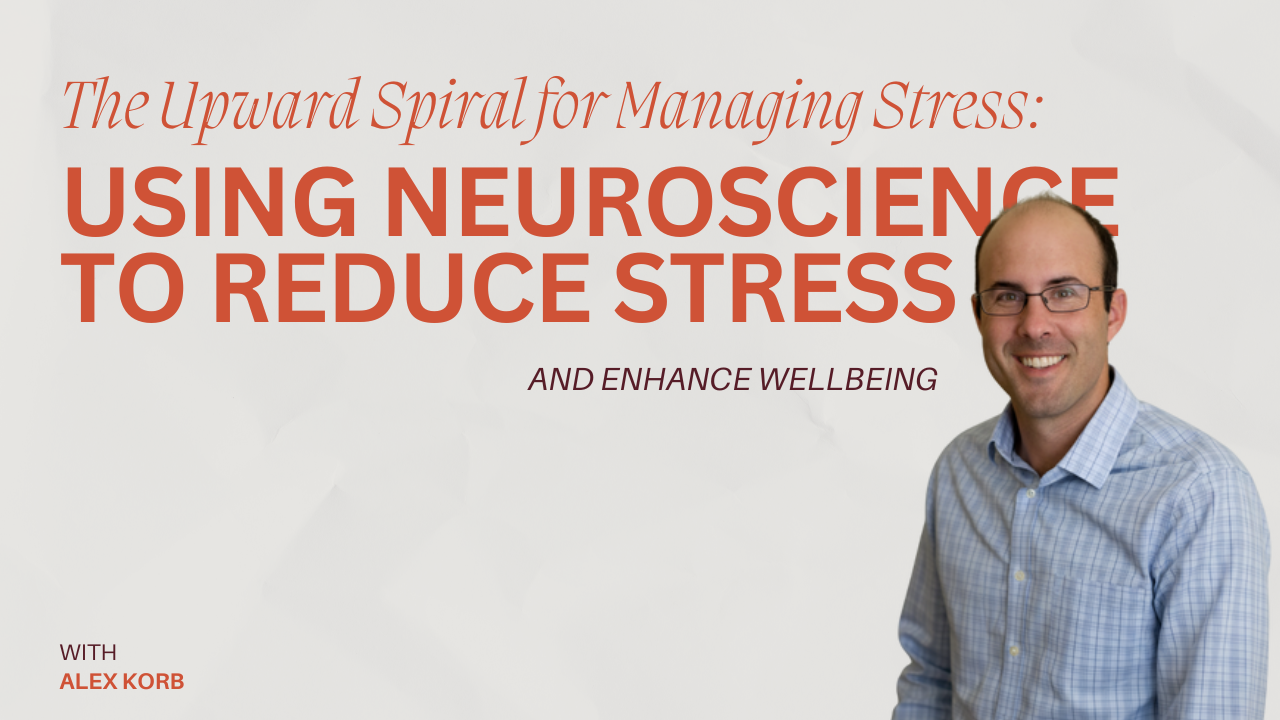
Most stress advice is generic, which is why so little of it lands. Alex Korb’s framework is three variables: controllability, certainty and consequences. How much of this can the person actually affect, how much is unknown, and how much rides on the outcome. Once you can name which of the three is doing the damage, you know which lever you are reaching for, and you stop handing someone a technique aimed at the wrong one.
The controllability part is the one that changes how people think. The past is not controllable at all. Other people are barely controllable. The future is only partly controllable, because it is what you do now plus a great deal you have no say over. Even emotions sit in that partial category. The more attention someone gives to the uncontrollable end of that list, the worse they feel, and attention is something they can move.
Korb is a UCLA neuroscientist and the author of The Upward Spiral. Across two and a half hours he covers what stress actually is physiologically, the two halves of the autonomic nervous system and what each is for, and the limbic circuitry that certainty and control are quietly modulating. He is clear that stress is not the enemy: the response exists because it keeps people careful when care is warranted. Then the practical half, which is largely about attention: where it goes, why positive memory has a measurable effect when you sit inside it rather than glance at it, how to use your physical environment as a set of reminders, and gratitude used as a specific practice rather than an attitude.
You’ll walk away with
- The three Cs of stress, controllability, certainty and consequences, and which intervention each one calls for
- Why focusing on the past, on other people, or on the future reliably raises anxiety, and what to do instead
- What stress is physiologically, and the two complementary halves of the autonomic nervous system
- Why the stress response is useful, and what changes when it is running continuously
- The limbic circuitry involved, in terms you could explain to a client
- Attention as the most workable lever, since it is the one thing reliably under a person’s control
- Positive memory used properly: immersing in one rather than recalling it, and what that does
- Arranging a physical environment so it prompts the attention you want, without effort
- Gratitude as a practice, including the journal and what makes it work rather than not
- Why deliberately facing the worst-case scenario can reduce distress rather than increase it
- Where values come in, and how having them clear keeps stress from becoming overwhelming
Watch the course trailer
CPD Information For Mental Health Professionals
Enjoy complete flexibility with 100% self-paced learning you can access anytime, anywhere, and on any device. This course is included with your Tatra Training membership, along with every other course in the library.
Please note: this was recorded during the COVID-19 lockdowns and Alex Korb uses that period throughout as his worked example. The framework and the practices are not specific to it.
Where this sits: the short version. One of the three sessions here is the same recording as Session 13 of The Upward Spiral: Using Neuroscience to Reverse the Course of Depression, which is the full twelve-hour programme. Take this one first if you want the stress framework on its own.
Format: Alex Korb addresses you directly and asks you to apply each step to your own life. Clinicians use it both ways, for client work and for themselves.
Course Duration: 2.5 learning hours
Certificate and CPD hours: On completion you’ll receive a Certificate of Completion to support your CPD records. Your certificates are yours to keep.
Assessment: Complete a short quiz at the end (80% pass mark), which you can resit as many times as needed.
Revisit Anytime: Come back to the course as often as you like while your membership is active, whenever you want a refresher for practice.
CPD Eligibility: This program may be suitable for CPD for professionals such as:
- Psychologists
- Counsellors and Psychotherapists
- Social Workers
- Community Workers
- Mental Health Nurses
- General Practitioners (GPs)
- Occupational Therapists
CPD requirements vary between professional bodies, so please check with your association or credentialing body to confirm you can claim CPD hours/OPD points for this program and what evidence they require.
Course Content
Meet Your Instructor

When clinicians need practical, brain-based strategies to help clients break free from depression and anxiety cycles, they turn to Alex Korb. His evidence-backed approach shows practitioners how small neuroplasticity shifts can create lasting change for their most challenging cases.
With over 20 years in neuroscience research at UCLA's Department of Psychiatry and Biobehavioral Sciences, Korb is the bestselling author of The Upward Spiral, the definitive guide that translates complex depression neuroscience into actionable clinical tools. His decade-long coaching practice has refined methods that help clients rewire stress responses and unlock resilience - insights he now shares with mental health professionals through his signature training programs.
Korb's clinical focus spans depression, anxiety, and mood disorders, with special expertise in neuromodulation and wellbeing interventions. His approach combines rigorous neuroscience with practical mindfulness techniques, giving clinicians concrete protocols they can implement immediately. Rather than abstract theory, he teaches practitioners how brain circuits actually change through targeted interventions, making treatment planning more precise and outcomes more predictable.
What sets his training apart is real-world application. Korb has coached hundreds of clients while maintaining active research at UCLA, so he understands both the science and the messy realities of clinical work. His methods help clinicians identify which neural pathways to target for specific symptoms, how to sequence interventions for maximum impact, and ways to help clients maintain progress between sessions.
For your practice, expect to gain specific techniques for interrupting rumination cycles, practical tools for building client resilience, and clear frameworks for explaining brain-based healing to clients in ways they understand and embrace.
Quick Win: Korb's "neural momentum" principle teaches that tiny consistent actions create more lasting brain change than major sporadic efforts—a game-changer for client motivation and treatment compliance.
Qualifications
- Ph.D., Neuroscience, UCLA, 2010
- B.S., Neuroscience, Brown University, 2002
- Adjunct Assistant Professor, UCLA Department of Psychiatry & Biobehavioral Sciences
- Over a dozen peer-reviewed publications in depression and neuromodulation research
Authored Books
- The Upward Spiral: Using Neuroscience to Reverse the Course of Depression, One Small Change at a Time (2015)
Featured & Recognition
- Psychology Today blog columnist (PreFrontal Nudity)
- Curable Health podcast guest (2019)
- LawyersWithDepression interview (2022)
Teaching & Roles
- Adjunct Assistant Professor, UCLA Department of Psychiatry & Biobehavioral Sciences, 2010–present
- Coach and Founder, Upward Spiral Coaching, Los Angeles, 2015–present
- Consultant, Parent Lab Inc., 2018–2025
Feedback & Reviews
This course includes:
- Lessons 4
- Topics 0
- Duration 2.5 hours
- Quizzes 1
- Language English