

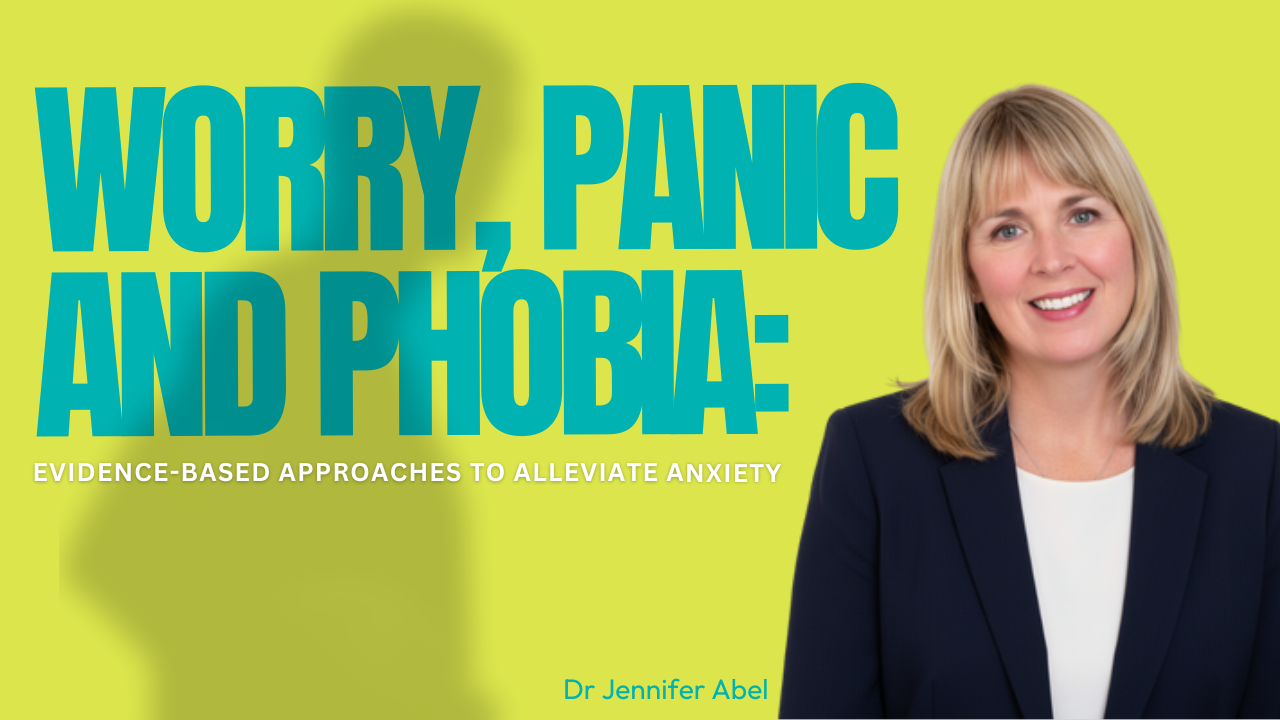
Worry, Panic and Phobia: Evidence-Based Approaches to Alleviate Anxiety

Worry is transdiagnostic and is frequently the seed of depressive disorders and more severe anxiety disorders. Therefore understanding the nature of worry and how to treat it is paramount for all mental health care providers.
People often worry their way into a panicked state, which is not the same as suffering from a true panic attack; likewise the treatment approaches are different. Anxiolytics, usually benzodiazepines, negatively reinforce anxiety and thereby potentiate the fear of panic attacks, while only treating the symptoms. These are among the reasons that cognitive-behavioral approaches are literally twice as effective as medication in treating panic. Panic attacks are common amongst people who have phobias, therefore it is sometimes necessary to address panic attacks when treating phobias.
This seminar includes demonstrations, film clips, case examples and humor to teach you evidence-based approaches to help all of your clients worry and stress less. You will learn more about the nature of panic attacks, worry, and anxiety as well as the concomitant treatment approaches to alleviate generalised anxiety disorder, panic disorder and specific phobia.
Learning Objectives:
This training will provide participants clinical knowledge and tools to:
- State at least four reasons why it is important to assess and potentially treat worry in all clients.
- Communicate the two most important facts about the nature of worry, how they guide treatment for generalised anxiety disorder, and learn several evidence-based techniques to alleviate worry and anxiety.
- Analyse and understand operant conditioning, why many professionals misunderstand it, and why abating negative reinforcement is crucial in the treatment of most anxiety disorders.
- Name and learn to practice seven types of exposure therapy.
- Learn and understand how to put clients and patients at ease that while there is a physiological rationale for their panic attacks, they are not caused by a medical problem or genetics.
- Learn and practice how to cure panic attacks in 90% of clients with mindful acceptance and interoceptive exposure.
- Learn and acquire skills to treat phobias.
CPD Information For Mental Health Professionals
Enjoy complete flexibility with 100% self-paced learning you can access anytime, anywhere, and on any device. Pay once for lifetime access.
Course Duration: 6 learning hours
Certificate and CPD hours: On completion you’ll receive a Certificate of Completion to support your CPD records.
Assessment: Complete a short quiz at the end (80% pass mark), which you can resit as many times as needed.
Lifetime Access: Your access to the course does not expire, so you can revisit key concepts anytime you want a refresher for practice.
CPD Eligibility: This program may be suitable for CPD for professionals such as:
- Psychologists
- Counsellors and Psychotherapists
- Social Workers
- Community Workers
- Mental Health Nurses
- General Practitioners (GPs)
- Occupational Therapists
CPD requirements vary between professional bodies, so please check with your association or credentialing body to confirm you can claim CPD hours/OPD points for this program and what evidence they require.

Course Content
Meet Your Instructor

Anxiety disorders that resist standard treatments - chronic worry, panic attacks that won't respond to typical interventions, and performance anxiety that derails careers - can sometimes need more than generic cognitive-behavioral approaches to create lasting change. Jennifer Abel has spent over 30 years specialising exclusively in anxiety disorders, becoming one of the world's leading experts in treating resistant anxiety presentations and developing innovative strategies that help clients achieve rapid relief where other approaches have failed.
As former Assistant Director of Penn State's Stress and Anxiety Disorders Institute under T.D. Borkovec (the leading expert in Generalised Anxiety Disorder), Dr. Abel represents the highest level of expertise in evidence-based anxiety treatment. Her bestselling books - including The Anxiety, Worry, & Depression Workbook (4.6/5 stars with 450+ Amazon ratings) and the popular Melt Worry & Relax Card Deck - have helped thousands of practitioners and clients worldwide. Her invitation by the Association for Behavioral and Cognitive Therapies to write their GAD pamphlet reflects her recognition as a premier authority in worry and anxiety treatment.
Dr. Abel's expertise spans all anxiety disorders with particular specialisation in Generalised Anxiety Disorder, panic disorder, OCD, performance anxiety, insomnia, and compassion fatigue. Her integrative approach combines cognitive-behavioral therapy with mindfulness, schema therapy, DBT, and ACT techniques, creating personalised treatment plans for clients who haven't responded to standard protocols. She specialises in helping athletes and musicians enhance performance without medication, treating resistant anxiety presentations, and working with high-achievers whose anxiety interferes with their professional success.
What sets her training apart is practical innovation combined with deep research expertise. Abel doesn't just teach textbook techniques - she shows practitioners how to adapt evidence-based interventions for clients who don't fit standard presentations. Her workshop evaluations consistently rate above 4.25 out of 5, with some participants calling her training "the most informative and skill-building workshop" they've attended.
For your practice, expect to gain specific techniques for treatment-resistant anxiety, innovative interventions for chronic worry, and tools for working with performance-focused clients. Her approach particularly benefits clinicians working with high-achievers, those struggling with standard CBT outcomes, or practitioners wanting specialised expertise in anxiety disorders.
Quick Win: Abel's "worry postponement" technique helps clients reduce rumination by scheduling specific worry times - often providing relief within days and creating space for more productive coping strategies.
Qualifications
- Ph.D., Adult Clinical Psychology, West Virginia University, 1987–1992
- Post-Doctoral Studies, Penn State University, 1992–1994
- M.A., Adult Clinical Psychology, West Virginia University
- B.A., Psychology and Music, University of Missouri, Kansas City, 1981–1984
- Licensed for teletherapy in 35–40+ states
- 30+ years specialising in anxiety disorders
Authored Books
- The Anxiety, Worry, & Depression Workbook: 65 Exercises, Worksheets & Tips to Improve Mood and Feel Better (bestseller, 4.6/5 stars, 450+ Amazon ratings)
- Melt Worry & Relax Card Deck: 56 CBT & Mindfulness Strategies to Release Anxiety
- Resistant Anxiety, Worry, and Panic: 86 Practical Treatment Strategies for Clinicians (2014)
- Active Relaxation: How to Increase Productivity and Achieve Balance by Decreasing Stress and Anxiety (2010)
- Melt Worry & Relax Card Deck for Kids (co-author, in press, includes art therapy)
Professional Experience
- International Speaker & Author, Anxiety Expert, 2018–present
- Clinical Psychologist, Private Practice, St. Louis, MO, 1994–2018, 2022–present
- Assistant Director, Stress and Anxiety Disorders Institute, Penn State University (post-1994)
Training & Education
- Internship, University of Mississippi Medical Center (Panic Disorders, Eating Disorders, PTSD rotations)
- Practicum, Anxiety Disorders Center, Chestnut Ridge Hospital
- Practicum, FCI Morgantown Prison (behavioral medicine focus)
International Training
- Professional trainer for mental health professionals in USA, Canada, Australia
- Over 300 workshops and seminars delivered
- Specialised programs in performance enhancement and anxiety treatment
Clinical Specialties
- Generalised Anxiety Disorder (GAD) and chronic worry
- Treatment-resistant anxiety presentations
- Performance anxiety for athletes and musicians (non-medication approaches)
- Panic disorder and agoraphobia
- Obsessive-Compulsive Disorder (OCD)
- Social anxiety and phobias
- Insomnia and sleep anxiety
- Compassion fatigue and burnout in healthcare professionals
Ready to help anxiety clients achieve breakthrough results where standard treatments have failed? Discover how Dr. Abel's innovative, research-backed strategies can help transform your ability to treat even the most resistant anxiety presentations with confidence and effectiveness.
Feedback & Reviews
This course includes:
- Lessons 5
- Topics 0
- Duration 6 hours
- Quizzes 1
- Language English