
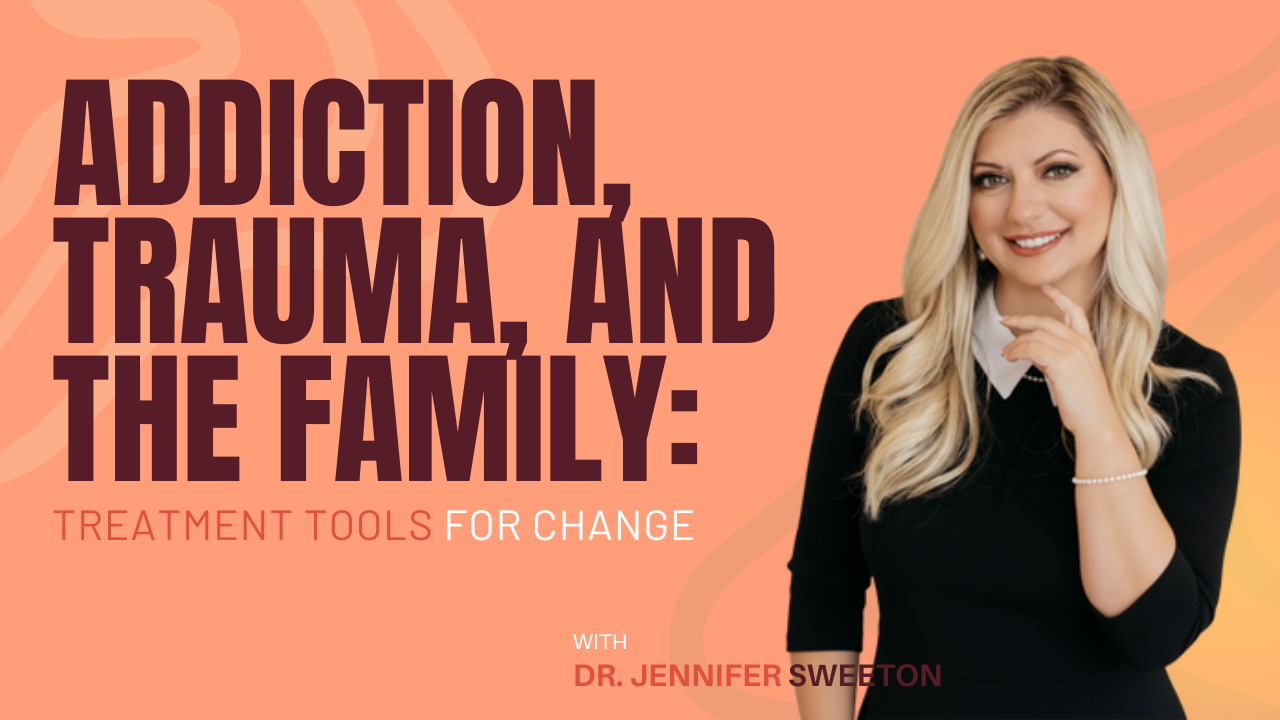
Addiction, Trauma, and the Family: Treatment Tools for Change
She has counted the bottles, checked the car, taken over the mortgage and the school run, and she is sitting in front of you asking how to make him stop. Then you use the word enabling, or codependent, or boundaries, and you can feel her close. She has heard it before, from her sister and her friends, and what she heard was that she loves him wrong.
Jennifer Sweeton’s case is that the framing is costing you the client. The prodependence model flags the same behaviours the codependence model does, but from a different starting point. Not loving too much, loving ineffectively. Not controlling, trying very hard to be heard. Not in denial, unwilling to give up hope that the person she married is still well. Everything that needs to change still needs to change. She does not have to be diagnosed to get there.
That is a clinical position, not a gentler one. Roughly nine in ten people with an addiction have a history of childhood trauma, which makes addiction a disorder of attachment before it is anything else. Push the codependence lens hard enough and the family ends up severed, the supporter isolated, and the person with the addiction stripped of the last connection they had. Space is sometimes necessary. Abandonment is not the goal.
The rest of the five and a half hours gives you what the supporter needs. Language for what addiction is doing in a brain, so a partner stops hearing it as a series of choices aimed at them. The family roles and the phases of addiction, so you can locate where someone is stuck and name what is holding them there. And the practical work of boundaries, self-care and the moment a supporter has to stop being the only thing standing between someone and disaster.
The supporter is usually the only person in that family who has walked into a therapy room. What happens in the first few sessions decides whether they come back.
You’ll walk away with
- The prodependence reframe and the specific language swaps that go with it, so you can name a behaviour as ineffective without naming the person as sick
- The clinical case for that framing: if addiction rests on an attachment injury, severing the last attachment works against the treatment rather than for it
- Plain-language neuroscience a supporter can actually use, including why the person cannot simply decide to stop, and why they are likely to be flat and joyless for months after they do
- The six family roles, and how the work differs depending on which one has come to see you
- The six phases of addiction, how to work out which one a supporter is in, and the specific beliefs that keep people stuck in the middle three for years
- Boundaries designed to protect rather than punish, set small enough that they will actually be enforced, plus what to do with “I already tried that and she broke it”
- A way to answer the supporter who is still waiting for their approach to start working, by getting them to name in advance what would tell them it has not
- A measured response to suicide threats used to hold a supporter in place, that neither dismisses the risk nor leaves them as the only safety net
- A notes-to-self method for the supporter to hold onto their own perspective at the moment they are pulled back in and lose it
- Sweeton’s reasoning for postponing the deeper trauma work, and why going deep while the crisis is live tends to set treatment back
Watch the course trailer
CPD Information For Mental Health Professionals
Enjoy complete flexibility with 100% self-paced learning you can access anytime, anywhere, and on any device. This course is included with your Tatra Training membership, along with every other course in the library.
Course Duration: 5.5 learning hours
Certificate and CPD hours: On completion you’ll receive a Certificate of Completion to support your CPD records. Your certificates are yours to keep.
Assessment: Complete a short quiz at the end (80% pass mark), which you can resit as many times as needed.
Revisit Anytime: Come back to the course as often as you like while your membership is active, whenever you want a refresher for practice.
CPD Eligibility: This program may be suitable for CPD for professionals such as:
- Psychologists
- Counsellors and Psychotherapists
- Social Workers
- Community Workers
- Mental Health Nurses
- General Practitioners (GPs)
- Occupational Therapists
CPD requirements vary between professional bodies, so please check with your association or credentialing body to confirm you can claim CPD hours/OPD points for this program and what evidence they require.
Course Content
Meet Your Instructor

Trauma survivors whose PTSD symptoms resist traditional therapy approaches - and clinicians struggling to understand how neuroscience can enhance treatment - may need more than generic trauma protocols to help create lasting healing. Jennifer Sweeton has spent her career bridging cutting-edge neuroscience research with practical clinical application, becoming an internationally recognised expert who has revolutionised how practitioners understand and treat trauma through brain-based interventions.
As a Stanford-educated clinical and forensic psychologist with doctoral training at Stanford University School of Medicine and a master's degree in affective neuroscience, Dr. Sweeton represents the pinnacle of scientific rigor applied to trauma treatment. Her Amazon #1 bestselling book Trauma Treatment Toolbox and recognition by Shortform as one of the "100 Best Trauma Books of All Time" demonstrate her ability to translate complex neuroscience into practical tools. Her recent completion of her JD from the University of Missouri-Kansas City adds crucial legal expertise to her forensic psychology practice, making her uniquely qualified for complex cases involving legal proceedings.
Dr. Sweeton's expertise spans PTSD treatment, the neuroscience of mental health, forensic assessment, women's issues, anxiety disorders, and legal aspects of mental health. Her approach integrates evidence-based trauma therapies with cutting-edge understanding of neuroplasticity and brain-based healing. She is the developer of Neural Desensitisation and Integration Training (NDIT), an evidence-informed modular psychotherapy for PTSD that specifically targets neuroplasticity in key brain regions. Her specialisation includes complex trauma presentations, forensic evaluations for legal proceedings, and cases where standard trauma treatments have been ineffective.
What sets her training apart is rigorous science combined with practical application. As a world-renowned trauma treatment expert, Sweeton doesn't just teach trauma techniques - she shows practitioners how specific interventions create measurable changes in brain structure and function. Her experience training over 60,000 mental health professionals worldwide demonstrates her exceptional ability to make neuroscience accessible to practicing clinicians.
For your practice, expect to gain brain-based trauma interventions, specific techniques for treatment-resistant PTSD, and forensic assessment skills for legal cases. Her approach particularly benefits clinicians wanting to integrate neuroscience into their trauma work, those dealing with complex forensic cases, or practitioners seeking advanced training in evidence-based PTSD treatment.
Quick Win: Sweeton's "neural pathway mapping" technique helps clients understand how trauma affects specific brain regions - helping to reduce shame and increase treatment engagement by showing that PTSD symptoms reflect brain changes, not personal weakness.
Qualifications
- PsyD, Clinical Psychology, PGSP-Stanford PsyD Consortium, 2012
- MS, Clinical Psychology, PGSP-Stanford PsyD Consortium, 2010
- MA, Personality Psychology (Affective Neuroscience), Stanford University, 2007
- BS, Cognitive Psychology, University of Kansas, 2004
- JD, University of Missouri-Kansas City School of Law, 2025
- Licensed Clinical & Forensic Psychologist
- Training: Stanford University School of Medicine, Pacific Graduate School of Psychology, National Center for PTSD
Authored Publications
- Traumatic Stress Recovery Workbook (2025)
- Trauma Treatment Toolbox (Amazon #1 bestseller, Shortform's "100 Best Trauma Books of All Time")
- Eight Key Brain Areas of Mental Health and Illness
- Train Your Brain Card Deck: 100 Techniques to Heal Trauma and Build Resiliency
- Multiple book chapters and professional publications
Leadership & Teaching
- Founder/Co-owner, Kansas City Mental Health Associates (group private practice)
- Former President, Greater Kansas City Psychological Association & Oklahoma Psychological Association
- Adjunct Faculty, University of Kansas School of Medicine & University of Oklahoma Health Sciences Center
- Developer, Neural Desensitisation and Integration Training (NDIT) for PTSD
Professional Experience
- Director of Behavioral Health, Clinton Service Unit, Indian Health Service, 2015–2016
- Telemental Health Psychologist, Oklahoma City VA Medical Center, 2013–2015
- Combat Stress Recovery Postdoctoral Fellow, University of Oklahoma Health Sciences Center/Oklahoma City VA, 2012–2013
Training & Speaking
- Trained over 60,000 mental health professionals internationally
- Keynote speaker, trainer, and workshop leader worldwide
- Sought-after expert for legal, corporate, government, and community education events
- Developer of continuing education programs serving 50,000+ licensed mental health providers
Ready to integrate cutting-edge neuroscience with trauma treatment? Discover how Dr. Sweeton's brain-based interventions can transform your ability to help trauma survivors achieve lasting recovery through evidence-based approaches that target specific neural pathways.
Feedback & Reviews
This course includes:
- Lessons 4
- Topics 0
- Duration 5.5 hours
- Quizzes 1
- Language English