

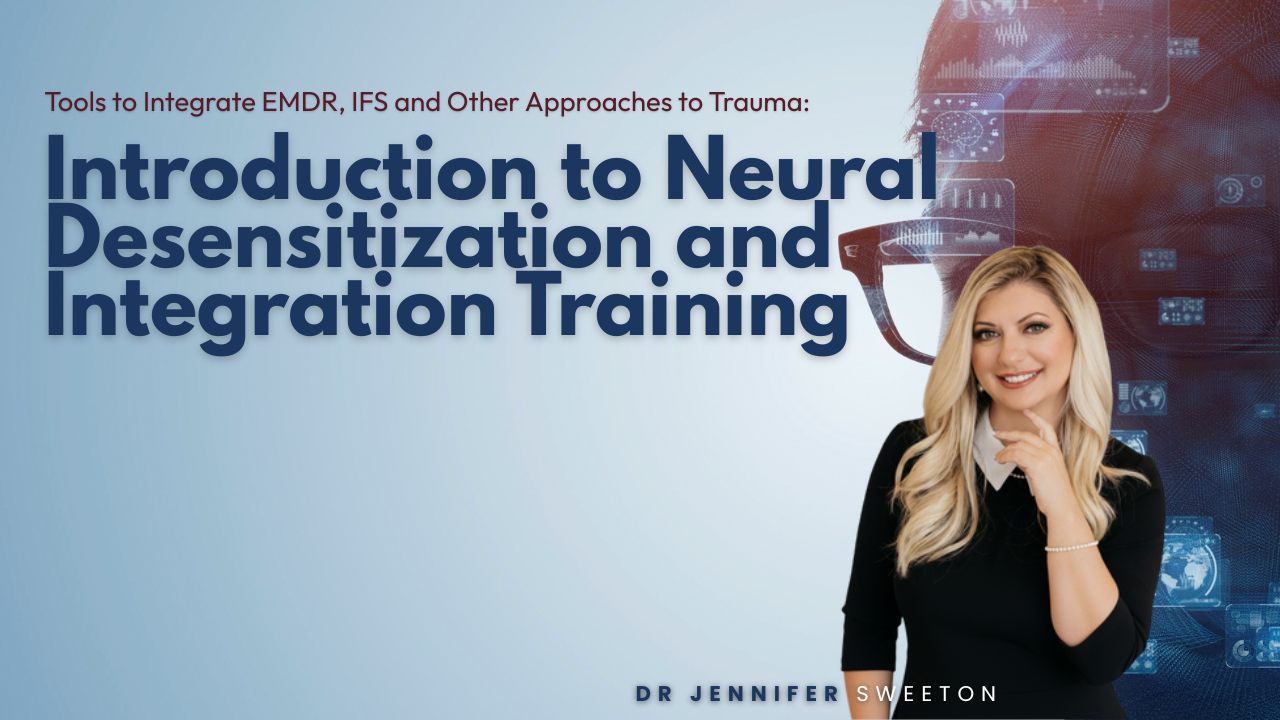
Tools to Integrate EMDR, IFS and Other Approaches to Trauma: Introduction to Neural Desensitization and Integration Training

Members
Already a Tatra member?
Log in to start this course, pick up where you left off, or save it to your favourites for later.
Not a member yet?
This course is included in Tatra membership
- Try it free for 7 days
- Learn from our entire 150+ course library for what one course costs.
- Watch on desktop, TV or mobile, whenever it suits you
- New courses added regularly
- CPD certificate when you complete each course
Some clients cannot give you what the protocol asks for. There is no image of the worst moment, because they were drugged, or asleep, or too young to hold one. There is no negative cognition, because nothing they believe about themselves quite matches what happened. You are sitting with someone who is clearly carrying trauma, holding a method that will not start.
Jennifer Sweeton built Neural Desensitization and Integration Training around what the brain science says about trauma networks rather than around a fixed set of entry conditions. A trauma network holds sensations, emotions, beliefs, thoughts and memories together, and activating any one of them lights up the rest. So the way in can be a tight chest, a sound, an environmental reminder, a belief or a memory. Whatever the client brings you is a way in.
This course covers module five of the NDIT sequence, trauma processing. Sweeton works through the neural profile of trauma, how to select a target when a client has several, how to structure the recall, and the three categories of contradictory experience you pair with that recall to bring the distress down. She is also clear about why the order of the modules matters, and why cognitive work lands badly while the amygdala is still running hot.
You’ll walk away with
- A way to map a client’s trauma network on one worksheet: the sensations, emotions, beliefs, thoughts and memories sitting inside it
- The ability to start trauma processing with clients who have no image and no negative cognition, using a sensation, sound or thought as the point of entry
- A method for choosing a target when a client presents with several traumas, or tells you they all feel equally bad
- A way to decide with the client whether to work with the whole memory or one hotspot, and whether to speak it, write it or hold it in mind
- The memory reconsolidation sequence, so you can pair recall with a contradictory experience instead of leaving the client sitting in the distress
- Practical use of bilateral movement, eye placement shifts and other distractions, at a speed that keeps the memory accessible but tolerable
- Ways to shift a client’s physiology mid-recall using breath, muscle work and grounded poses, and why that speeds desensitisation rather than diluting it
- Psychological distancing techniques: shrinking and blurring images, changing colour, altering a remembered voice, adding the moment safety returned
- A clear read on the difference between a client who is bored because they have desensitised and one who has gone numb, and what to do when it is numbing
- The situations where this work should wait, including pending litigation tied to the trauma, a history of seizures and active psychosis
Watch the course trailer
CPD Information For Mental Health Professionals
Enjoy complete flexibility with 100% self-paced learning you can access anytime, anywhere, and on any device. This course is included with your Tatra Training membership, along with every other course in the library.
Course Duration: 6 learning hours
Certificate and CPD hours: On completion you’ll receive a Certificate of Completion to support your CPD records. Your certificates are yours to keep.
Assessment: Complete a short quiz at the end (80% pass mark), which you can resit as many times as needed.
Revisit Anytime: Come back to the course as often as you like while your membership is active, whenever you want a refresher for practice.
CPD Eligibility: This program may be suitable for CPD for professionals such as:
- Psychologists
- Counsellors and Psychotherapists
- Social Workers
- Community Workers
- Mental Health Nurses
- General Practitioners (GPs)
- Occupational Therapists
CPD requirements vary between professional bodies, so please check with your association or credentialing body to confirm you can claim CPD hours/OPD points for this program and what evidence they require.
Not a member yet?
Start Your 7 Day Free TrialCourse Content
Meet Your Instructor

Trauma survivors whose PTSD symptoms resist traditional therapy approaches - and clinicians struggling to understand how neuroscience can enhance treatment - may need more than generic trauma protocols to help create lasting healing. Jennifer Sweeton has spent her career bridging cutting-edge neuroscience research with practical clinical application, becoming an internationally recognised expert who has revolutionised how practitioners understand and treat trauma through brain-based interventions.
As a Stanford-educated clinical and forensic psychologist with doctoral training at Stanford University School of Medicine and a master's degree in affective neuroscience, Dr. Sweeton represents the pinnacle of scientific rigor applied to trauma treatment. Her Amazon #1 bestselling book Trauma Treatment Toolbox and recognition by Shortform as one of the "100 Best Trauma Books of All Time" demonstrate her ability to translate complex neuroscience into practical tools. Her recent completion of her JD from the University of Missouri-Kansas City adds crucial legal expertise to her forensic psychology practice, making her uniquely qualified for complex cases involving legal proceedings.
Dr. Sweeton's expertise spans PTSD treatment, the neuroscience of mental health, forensic assessment, women's issues, anxiety disorders, and legal aspects of mental health. Her approach integrates evidence-based trauma therapies with cutting-edge understanding of neuroplasticity and brain-based healing. She is the developer of Neural Desensitisation and Integration Training (NDIT), an evidence-informed modular psychotherapy for PTSD that specifically targets neuroplasticity in key brain regions. Her specialisation includes complex trauma presentations, forensic evaluations for legal proceedings, and cases where standard trauma treatments have been ineffective.
What sets her training apart is rigorous science combined with practical application. As a world-renowned trauma treatment expert, Sweeton doesn't just teach trauma techniques - she shows practitioners how specific interventions create measurable changes in brain structure and function. Her experience training over 60,000 mental health professionals worldwide demonstrates her exceptional ability to make neuroscience accessible to practicing clinicians.
For your practice, expect to gain brain-based trauma interventions, specific techniques for treatment-resistant PTSD, and forensic assessment skills for legal cases. Her approach particularly benefits clinicians wanting to integrate neuroscience into their trauma work, those dealing with complex forensic cases, or practitioners seeking advanced training in evidence-based PTSD treatment.
Quick Win: Sweeton's "neural pathway mapping" technique helps clients understand how trauma affects specific brain regions - helping to reduce shame and increase treatment engagement by showing that PTSD symptoms reflect brain changes, not personal weakness.
Qualifications
- PsyD, Clinical Psychology, PGSP-Stanford PsyD Consortium, 2012
- MS, Clinical Psychology, PGSP-Stanford PsyD Consortium, 2010
- MA, Personality Psychology (Affective Neuroscience), Stanford University, 2007
- BS, Cognitive Psychology, University of Kansas, 2004
- JD, University of Missouri-Kansas City School of Law, 2025
- Licensed Clinical & Forensic Psychologist
- Training: Stanford University School of Medicine, Pacific Graduate School of Psychology, National Center for PTSD
Authored Publications
- Traumatic Stress Recovery Workbook (2025)
- Trauma Treatment Toolbox (Amazon #1 bestseller, Shortform's "100 Best Trauma Books of All Time")
- Eight Key Brain Areas of Mental Health and Illness
- Train Your Brain Card Deck: 100 Techniques to Heal Trauma and Build Resiliency
- Multiple book chapters and professional publications
Leadership & Teaching
- Founder/Co-owner, Kansas City Mental Health Associates (group private practice)
- Former President, Greater Kansas City Psychological Association & Oklahoma Psychological Association
- Adjunct Faculty, University of Kansas School of Medicine & University of Oklahoma Health Sciences Center
- Developer, Neural Desensitisation and Integration Training (NDIT) for PTSD
Professional Experience
- Director of Behavioral Health, Clinton Service Unit, Indian Health Service, 2015–2016
- Telemental Health Psychologist, Oklahoma City VA Medical Center, 2013–2015
- Combat Stress Recovery Postdoctoral Fellow, University of Oklahoma Health Sciences Center/Oklahoma City VA, 2012–2013
Training & Speaking
- Trained over 60,000 mental health professionals internationally
- Keynote speaker, trainer, and workshop leader worldwide
- Sought-after expert for legal, corporate, government, and community education events
- Developer of continuing education programs serving 50,000+ licensed mental health providers
Ready to integrate cutting-edge neuroscience with trauma treatment? Discover how Dr. Sweeton's brain-based interventions can transform your ability to help trauma survivors achieve lasting recovery through evidence-based approaches that target specific neural pathways.
Feedback & Reviews
This course includes:
- Lessons 5
- Topics 0
- Duration 6 hours
- Quizzes 1
- Language English